
What Is Strategic Planning?
Strategic planning, also known as strategic management, is the process of establishing long-term business goals and defining the process to achieve those goals. It involves looking into the organization’s future to identify its objectives before creating plans, implementing, and evaluating the results.
Strategic planning involves remodeling the organizational structure of businesses to best suit their goals. It also consists of allocating resources to the long-term priorities of an organization. It’s also important to note that, all parts of an organization are considered. Focuses on integrating all the departments (sales, marketing, finance, accounting, and HR) and then making a plan to accomplish strategic goals.
Strategies vs Tactics
Strategy: Intent, Determines what needs to be done & why, Involves intentional & focused high-level thinking that defines the direction to take, Aligned with the objectives, Requires focus on defining the future, Difficult to change though possible, Needs outward perspective, Formed by leaders within the organization, Primary focus on effectiveness & doing the right thing, Difficult to measure & evaluate, No details, and Intangible.
Tactic: Putting intent to action, Determines how it must be done, Involves concrete actions & steps to implementation in line with the direction, Aligned with strategy, Requires day-to-day execution, Easy to change, Needs inward view, Defined & executed by managers, Primary focus on efficiency & doing it right with less resources and money, Easy to evaluate through well-defined metrics, Tactical plans includes timelines & implementation, and Tangible.
Why Is Strategic Planning Important?
The Mission
The genesis of strategic planning is a clear mission that forms the framework of an organization’s purpose & direction. An organization’s mission statement outlines who it is, what it does, and where it wants to go.
The Goals
An organization needs measurable goals so everyone can determine how well the business performs against objectives & overall mission. Most strategic planning follows the SMART goal model or other objectively measurable goal models.
Alignment with Short-term Goals
Short-term, tactical business planning is a crucial part of strategic planning, as it helps business owners with everyday decision-making.
Evaluation & Revision
Strategic planning is done periodically to allow business owners time to evaluate progress and weigh it against the strategic plan. They can make changes and adjustments based on changing market conditions.
Steps In the Strategic Planning Process
Assess The Business Environment
A proper analysis of the business environment is the first step, the assessment is required to collect data on market trends & customer behaviors. It entails keeping an eye out for unusual changes. It also involves creative methods to capitalize on the company’s position in the market. Completing a study of your rivals & their recent behavior may also be helpful.
Evaluate Company’s Position
Your company’s position in the industry should be considered as the next step in your strategic planning. The step entails evaluating the company’s potential, appeal, and capabilities. Take into account how your mission statement can be: Be specific about your business, Be precise and succinct, and Encourage investors and staff.
Adjust or Create Your Vision Statement
A company’s vision statement outlines its long-term objectives and emphasizes the company’s final goal for the firm, which is why you created it in the first place. An effective vision statement is: describes the company’s values & cultures; extremely succinct; challenging but achievable objective.
Determine Your Strategic Goals
It’s critical to define your strategic goals so everyone involved in the company knows the importance of their contributions. It’s also essential that everyone in the company can work to make the firm successful.
Develop A Plan
Your project must be tactical and take all potential outcomes into account. Focus on organizing your goals in order of importance so that you can finish your most important tasks first. A sound strategic plan ensures that every business division is involved, has its own goals, and that every employee contributes to the organization’s overall objectives.
Implement & Monitor Your Plan
All plans must be implemented & monitored. So you can let the company’s key staff and all the relevant personnel know about it. The plan can be distributed to all departments, along with a list of their unique responsibilities and KPIs. Consider feedback systems & decide how you’ll record important information.
Analyze Results & Modify Your Plan
Track the success of your plan using the information you received from your feedback. Evaluating the effectiveness will take a while after implementing strategic plans. After the test, gather all the data and analyze it thoroughly. It would help if you adapted your plan to better support the organization’s objectives in light of new knowledge and reality.
Contents Of A Strategic Plan
Executive Summary
It primarily serves to quickly summarize critical elements of a business plan for stakeholders & investors, such as the company description, market analysis, and financial data.
Signature Page
It’s intended for executives to sign to show their approval.
Company Information
It can draw attention to the company’s value proposition, positioning in the market, and other pertinent information.
Vision & Mission Statements
These are statements that sum up the company’s values & objectives. You can also expand on the core values to highlight your organization’s beliefs.
Industry Analysis
It serves as a helpful reminder to those involved in the plan of any competition information or trends that are particularly helpful when considering the plan’s actions.
Plan of Action
It outlines your plan for achieving all goals thoroughly and openly.
Scorecard
A visual tool like your scorecard can make it easier for stakeholders to monitor your progress.
Elements of Strategic Planning
Vision Statement
It outlines how you picture your company, which ought to be consistently examined. You must convey that dream in a motivating way to your staff and clients. A consistent examination will ensure it reflects how you envision your business. A vision statement is a company’s strategic plan roadmap, so only minimal alterations are accommodated. Vision statements are not always irrevocable, you can go back and make any necessary revisions.
Mission Statement
It explains what you do right now, whereas a vision statement describes how you see your firm in the eyes of your stakeholders & customers. It explains what you do, for whom, and how. Your company’s mission statement should inform everything you do. A mission statement perfectly describes the “what” “who” and “why” of your business. It serves as a company’s operating manual.
Core Values
The core values describe your thoughts & actions. You can accomplish your goal & mission thanks to the principles you hold.
SWOT Analysis
SWOT stands for “strengths, weaknesses, opportunities, and threats”. It enables you to recognize and identify your company’s crucial elements, developments, and competitors.
Long-Term Goals
They are declarations that go beyond the vision & spell out how you intend to get there. This collection of objectives typically begins three years in the future & lasts for about five years, directly relating to the mission and vision statements.
Yearly Objectives
Each long-term goal should include a few one-year objectives that further your aims. Every plan should be as SMART as feasible. Following the creation of your yearly objectives, you could further divide each into short-term goals, which specify the actions & goals for the following three months to help you reach your manual goals. Your action plans are how you intend to carry out short-term objectives.
Action Plans
Every goal should have a strategy outlining how to accomplish it. The level of detail depends on the latitude within which your management & team will operate. The flexibility for individuals who adhere to the plan decreases with the amount of detail offered.
Principles of An Effective Strategy
Keep It Simple
Being simple and straightforward is one of the essential steps in achieving your goals & strategies. Keeping your strategy precise, easy to remember, and utilized as a compass every step of the journey. In addition, make your strategy realistic, practical, and implementable within the organization’s context.
Utilize The Most Promising Opportunity
You need a logical understanding & reasoning of your business to form a competitive perspective with another company or industry and focus efforts to make the best decisions while taking risks. Developing a new strategy by considering the needs of the future is a great way to think.
Validate With Multiple Mental Models
Temptations during business to achieve short-term goals have immediate effects, but focusing on long-term goals that produce long-term profits & gains is more beneficial. An excellent mental model to help us step outside of our comfort zones and make decisions that will benefit us in the long run. Another thinking strategy is using the inversion mental model to look for the opposite of what we want, the reverse questioning strategy can help us gain a better perspective and more valuable responses to the initial question by asking questions about presumptions & points of view.
Assign An Owner
The strength of a good plan comes from the conviction that it will work, the teamwork required to carry it out, and the assumption of accountability for the results.
Types Of Strategic Plans
Business
An organization’s competitive elements are the main emphasis of a business-centric strategic plan, which also creates chances for growth. The plans use a global-making process that includes assessing the external business environment, formulating objectives, and allocating financial, human, and technological resources to achieve those objectives.
Corporate
A corporate-centric plan outlines the organization’s operations. It focuses on structuring & coordinating senior leadership, corporate policies, and procedures to achieve desired goals.
Functional
Functional-centric strategic plans are integrated into corporate-level strategies and offer a detailed analysis of particular divisions of segments, such as marketing, HR, finance, and development.
What Is Strategic Management?
It’s a practice used by organizations most successful at matching their activities with their strategic plans. Strategy execution entails setting benchmarks, allocating finances & HR, and exercising leadership to achieve predetermined objectives. The strategy’s execution is strategic management, which is also known as strategy execution.
What Is A Strategy Map?
It’s a planning tool or template that assists stakeholders in seeing a company’s entire strategy as one connected graphic. These visual representations effectively comprehend and assess the causal connections between the many components of a company’s strategy.
The strategy map concentrates on the four key areas of categories: Finances, Customers, Internal Business Processes (IBPs), and Learning & Growth. A strategy map has a financial goal of cost reduction and an IBP goal of increased operational effectiveness. An action plan and set goals that can be aligned and carried through can be created from overall goals with a strategy map.
Benefits of Strategic Planning
It Encourages Preparedness
Planning entails actively pursuing specific objectives. As a result, businesses can plan because they know their activities & expectations throughout the entire business year. Companies that use strategic planning well can anticipate unfavorable circumstances & plan. Additionally, it enables businesses to adjust quickly to new changes, promoting adaptation & flexibility.
It Helps Set Specific Targets
An organization’s objectives are highlighted in a strategic plan. Short-term objectives are developed from long-term company goals in a sound strategic plan. Employees are always aware of what to do. Tasks in strategic plans often have deadlines, which fosters a sense of urgency.
It Boosts Productivity
Planning encourages resourcefulness & operational effectiveness. By decreasing trial & error and avoiding wasting valuable time & resources, strategic planning aids businesses in streamlining their operations. A sound strategic plan simplifies important & unimportant tasks, enabling management to direct resources & energies where they are most needed, increasing productivity.
It Increases Profitability
Strategic planning gives a business a crucial understanding of the market and its customers, enabling it to create profitable sales & marketing strategies. Sales targets are more easily met since employees know their roles & duties and how their work affects the business, thanks to KPIs & alignment.
It Prolongs A Company’s Lifespan
A solid strategic plan enables businesses to make wiser decisions. Because they are more concentrated on the goals they have established and the advantages they have understood are possible, a corporation with clear objectives and a game plan is less inclined to chase diversions.
Models of Strategic Planning
Basic Model
The basic model is good for developing a company’s vision, mission, business objectives, and values. This model assists you in outlining the specific steps required to achieve your goals, monitoring progress to keep everyone on track, and addressing issues as they arise. Vision – Goals – Approach – Action.
Alignment Model
It aims to align your business & IT strategies with the company’s strategic goals, which consist of strategic fit & functional integration. It integrates business and IT strategies. This model requires identifying an organization’s key goals and then determining how to achieve those goals. The plan must maximize the process. Outline – Identify – Adjust – Include.
The Balanced Scorecard
The BSC consists of clear communications about what has been accomplished. The model is designed to balance strategy and financial metrics. It prioritizes, measures, and monitors progress while aligning the work with the overall strategy. It allows you to see the connections between different aspects of your strategic plans. It is designed to provide managers with a comprehensive overview of their companies’ operations within short time frames. The model concerns five crucial factors: time, quality, performance, service, and cost.
OKR Strategic Planning Model
It consists of Objectives (they describe the outcome you want in the current quarter), Key results (these are specific measures that quantify your progress toward your objective), and To-dos (these small tasks correspond to each of your key results).
Blue Ocean Strategy
This strategy describes an uncontested market space for an unknown industry or innovation. It aims to make competition irrelevant & create and capture new demand. The blue ocean strategy seeks to create new market space, and the rewards of an entire ocean of uncontested market space are reaped.
Theory of Change (TOC)
It explains all the critical & ample set-ups essential to achieve long-term results, which entails planning in backward steps. TOC portrays attention to detail, which is plotted to incentivize succinct results at all levels of the change procedure. Identify the purpose of TOC – Develop vision & define desired change – Identify domains of change – Identify strategic priorities – Develop pathways of change – Review & adapt TOC.
The Hoshin Kanri Model
It aligns both vertically & horizontally, breaking your objectives into smaller ones and, eventually, into projects & tasks. Everyone is responsible for fulfilling the business strategy. The concept is that if you can break down and align your organization’s strategy from top to bottom, everyone in the company will align with your shared goals. Everyone will know how to achieve these goals. The model has seven key steps: Start with a vision – Develop 3-5 years of breakthrough objectives – Develop annual objectives – Deploy annual objectives – Implement annual objectives – Undertake regular progress reviews – Undertake regular annual reviews.
Issue-Based Strategic Planning Model
This model uses tools and analysis to understand the issues. It’s short-term (6-12 months), usually through a grouping and structure analysis approach. It allows you to design programs to address the issues in an organization. Identify—Suggest—Include.
Organic Model of Strategic Planning
The organic model helps a company prioritize its values and vision while working towards achieving its set goals and objectives. It sees an organization looking inward for practical solutions to stay ahead of the competition. Clarify, Articulate, Dialogue, Remind, Be Patient, Learn, and Reflect.
Real-Time Strategic Planning Model
It may be considered unorthodox, but it has a stand-out feature. The feature consists of a strategy that is quick & adaptable in addressing potential crises immediately. For companies, it’s common for well-detailed plans with a long-term outlook to become obsolete within 3-5 years. It can be categorized into three levels: Organizational Strategy (an outline of the company’s vision, value proposition, market competitors, market share, and trends); Programmatic Strategy (focuses on external research); Operational Strategy (focuses on internal research).
Scenario Model
It represents a contingency plan for companies that need to anticipate change or possibilities. It helps mitigate potential risks while similarly creating new opportunities & objectives. The changes include regulatory policy changes, rising prices, supply chain disruptions, and new players. External, Discuss, Suggest, Detect, Select.
7S Model
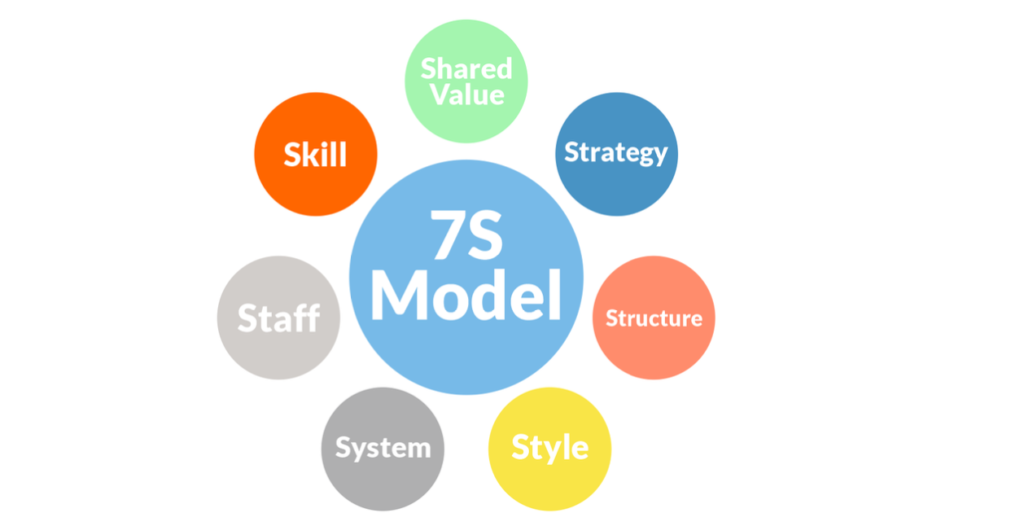
Structure refers to the components of your plan and how they work together to make your strategy achieve its pending goals, which aids the strategy’s effectiveness toward achieving its goals. It helps owners view their competitive environment from an elevated point of view, thus inevitably influencing their decisions & emergent strategies.
Strategy is the brain of a good strategic plan, highlighting an organization’s mission & vision. Honesty should be the best policy when implementing said strategy. It should give customers a bit of insight into an organization, its vision, and its mission to achieve estimated goals.
The system is the technical infrastructure that facilitates the daily workflow of a strategy is put into play. The system ensures versatility & ensures the smooth running of a plan put into play.
Skill: the success of a well-thought-out strategy is credited to a team of skilled members who worked meticulously on every step toward creating a well-planned strategy.
Style: team leaders’ management styles also influence the outcome of results. A good leader would maximize the efficiency of a skilled team, thus resulting in positive results.
Staff: the staff of an organization consists of employees. In this context, how they are recruited, trained, and motivated plays a big part.
Shared Values are an organization’s norms, values, and beliefs that guide staff behaviors, influence their decisions, and emphasize their actions & consequences.
The Cascade Model
Identify vision statement: it delineates why the organization exists, what it stands for, and what it was created to achieve. It highlights the organization’s primary purpose.
Define the company’s value: outline the organization’s values, how you want it to behave, and how it’s handled while striving towards its vision.
Craft your focus areas: highlight key areas that require your focus and effort to aid in the delivery of your organization’s vision.
Create your objectives: these are the goals you have set and want to achieve within a range of time.
Define your KPIs: each of the objectives you’ve set for yourself should contain at least two or more KPIs to keep tabs on your performance & measure if you’re close to or far away from reaching your objectives.
Specify your projects: it states your exact course of action to deliver on your objectives.
What Are Strategic Planning Tools?
They are methods, approaches, and models used by various organizations, individuals, and teams to ascertain and estimate their current position. The tools stipulate relevant benchmarks, standards, and criteria to make their objectives successful. They also lay out plans, views, and targets for organizations looking for long-term achievements. Examples are: Balanced Scorecard, SWOT Analysis, OKR, and PEST (Political, Economic, Sociocultural, and Technological) Analysis.
Porter’s Five Forces
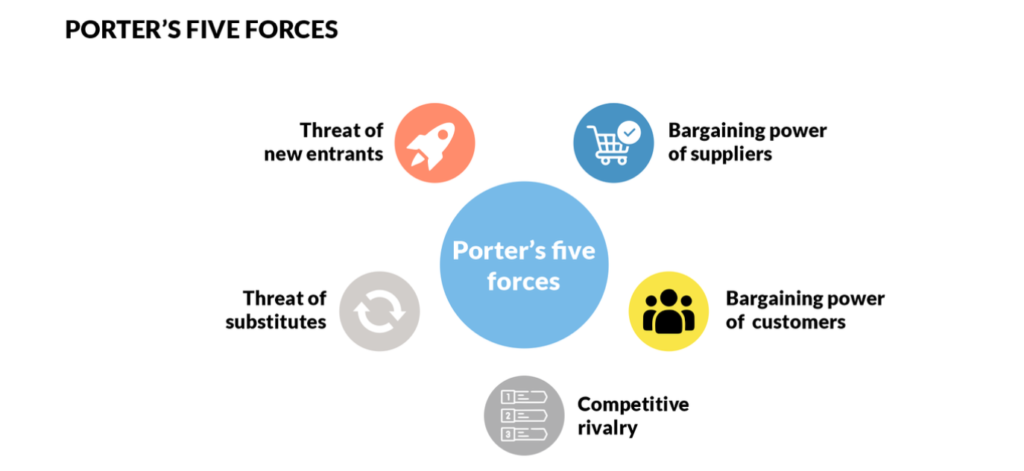
It’s a model that’s used to analyze the strong & weak points of an industry to determine corporate strategy. It will help understand the industry’s competition level & enhance a company’s long-term profitability. It is used to measure an industry’s or market’s competition intensity, attractiveness, and profitability.
Competition In The Industry
The most important of the five forces is the number of competitors and their ability to undercut an organization. It entails that the more competition there is with an equivalent amount of products to offer, the lesser the company’s power.
Potential of New Entrants Into An Industry
New entrants reduce a company’s power in its market. The less time & money spent by a new entrant to establish itself in a pre-existing company’s market as a competitor, the weaker the ability of the pre-existing one.
Power of Suppliers
This force affects companies with a codependent relationship with suppliers who supply quality input. Suppliers could quickly raise the prices of inputs because of the necessity of said inputs for the company.
Power of Customers
The ability to influence the cost of services rendered by a company also lies in the power of customers. A company with a small circle of customers has no choice but to give in to customer demands or risk searching for new customers & markets. A company with a large client base will quickly charge high prices for services rendered.
The Threat of Substitutes
Companies that produce irreplaceable top-of-the-line products and render quality services will have the power to increase prices as they see fit. Companies with replaceable products & services risk losing customers who opt for a cheaper substitute. This shift in customer preference will reduce the company’s estimated profits.
PESTLE Analysis
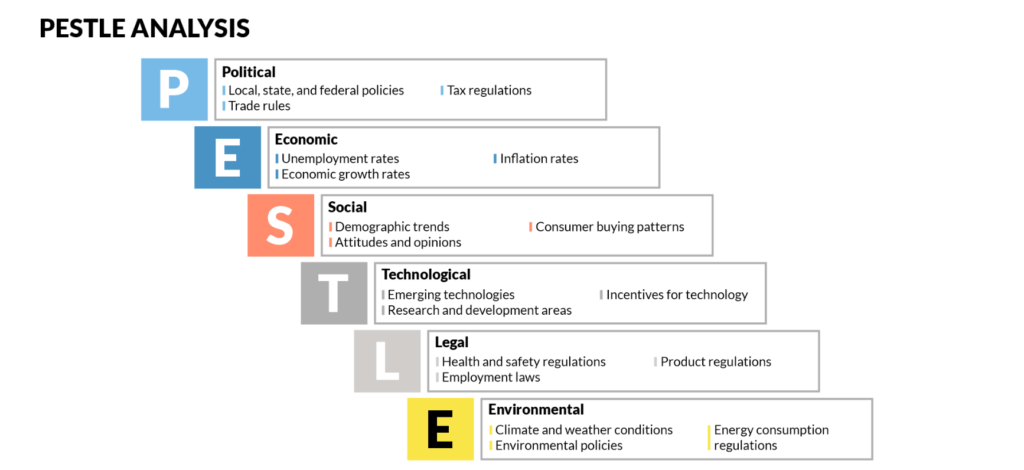
PESTLE (Political, Economic, Social, Technological, Legal, and Environmental) analysis is a concept in marketing principles used by companies to scope out an environment, where they are operating or planning to launch a new project, product, or service.
The main goal of PEST analysis is to help a company understand the external forces that can hinder its growth. It helps identify what factors could change in the future. It also helps in the development of a long-term strategy. PEST is best used for a broader research analysis of the business environment.
VRIO Framework
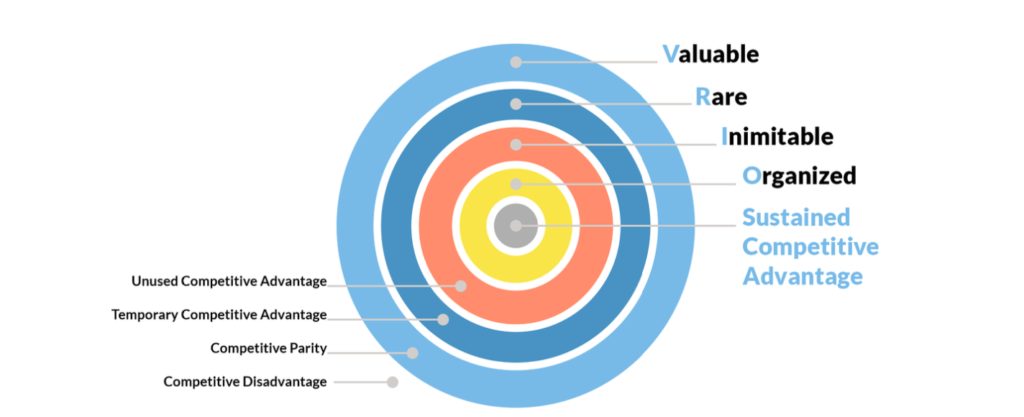
It helps a company identify and utilize its competitive advantages in the long run. It gives an organization the needed insight to secure its unique capabilities that competitors cannot easily replicate.
Value: whether your offering provides value or not to your target market/customer. If it does, you are at an advantage and can advance in your appraisal.
Rarity: it directly impacts the level of competition you will have to brave in the market. It’s ideal for offering a resource that is valuable yet rare.
Imitability: you can shift attention to your organization and curate exclusivity if you offer a resource with few alternatives. Your competitors will not be able to copy, imitate, or duplicate your product. The shift will make whatever advantage you have garnered more tangible and secure over a long period.
Organization: whether your organization has a structure to sustain its resources & competitive advantage or not. You’ll need adequate systems that will enable you to exploit your organization’s resources and protect them.
Conclusion
Strategic planning, or the absence of it, can make or break your business. In the beginning, developing a structured plan might be a stressful undertaking. Over time, however, it would prove invaluable for your organization’s market positioning. The structured plan would, in turn, help you serve your customers better, ultimately making you more money.