
Overview Of The Real Estate Industry
The involved parties are Developers, Brokerage, Sales & Marketing, Lending, Property Management, and Professional Services.
How does The Real Industry work?
Development: it refers to the process of buying up undeveloped land, changing the zoning on that land, building or renovating buildings, and then selling/renting such structures to target customers as a revenue stream.
Sales & Marketing: these companies are entitled to a proportional share of the earnings generated by advertising and the use of sales personnel to sell completed goods.
Brokerage: businesses that employ real estate brokers/realtors may be referred to as brokerages, they act as intermediaries between buyers and sellers of property.
Property Management: they encompass a wide range of responsibilities, such as collecting rent, resolving maintenance concerns, coordinating repairs, advertising vacant flats, and interacting with tenants. They require the landlord to pay a % of the monthly rent that is collected.
Lending: it may be done by a variety of different types of institutions, including but not limited to banks, credit unions, private lenders, and government agencies.
Professional Services: in addition to the above examples, the most common ones are those who work in accounting, the legal field, interior design, staging, general contracting, construction, and sales.
What Is Real Estate Business?
A real estate firm is an organization that deals with the purchase, disposal, administration, or investment of real estate. It is not only the land and structures but also the air rights over the land, as well as the subsurface rights below the land. The types can be Residential, Commercial, Industrial, or Vacant land.
Types of Real Estate Business
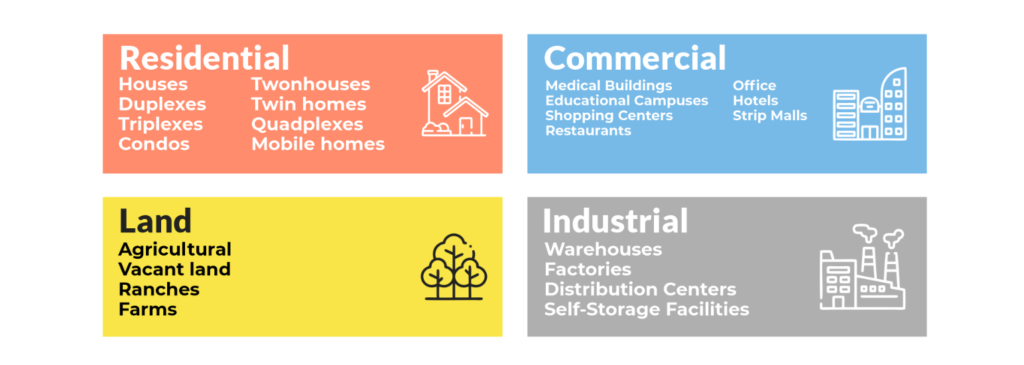
Land: it is the foundation for any other kind of property that may be classified as “real estate”, which also refers to any property that has the potential to be used for agricultural/ranching purposes. It’s a common practice for developers to rezone an area after purchasing neighboring pieces of property (assembly) to increase the density of the neighborhood and, the value of the houses they build.
Residential: under this category, there are a variety of housing alternatives available to pick from, such as single-family homes, apartments, vacation homes, duplexes, quadplexes, high-value homes, triple-deckers, multi-generational homes, condos, and townhouses.
Commercial: it consists of a variety of commercial constructions, including shopping malls, office buildings, schools, hotels, and other similar establishments.
Industrial: it often includes both warehouses and factories as one of its components. The buildings might operate as research facilities, storage facilities, manufacturing facilities, or distribution hubs. Warehouses that are used for storing commodities and shipping can be considered commercial properties.
Revenue Types of Real Estate Business
Many companies operate on a commission or fee basis, which means that they are not paid unless and until a transaction takes place. A wide variety of income streams including the following:
Residual Income: This might be bolstered by payments coming from a variety of sources, including income from rental properties, partnerships, commercial real estate, and interest.
Profit: the majority of real estate gains value through time or as a consequence of modifications made to it, such as increasing the net operating income (NOI), extending the square footage, or completing cosmetic renovations.
Business Operation Payments: if you are offering specialized services or engaging in commercial initiatives, you might expect your real estate company’s operations to bring in monetary compensation. This is common in commercial buildings, such as parking garages, eateries, and shopping malls.
Commissions: they make up the vast bulk of a real estate sales agent or broker’s income. In addition to financial incentives in the form of commissions for transactions that are successfully completed, many real estate businesses also pay their agents a small wage.
The Cost To Start A Real Estate Business
To get things rolling, you should probably plan on investing around $10,000 upfront. Here is the cost breakdown:
LLC Filling cost: $40 ~ $500; Pre-Licensing & Training: $200; Examination & Licensing: $300; Broker Fees: $500/month; Membership Dues: $200/year; Business Expenses: $3000/year; Marketing Costs: $1000~$3000/year; Continuing Education: $250/year.
Benefits Of A Real Estate Business
Cash Flow: if you invest in real estate, you will have the opportunity to lease out the space you own to other people. Recurring installments of the rent will be sent over to you.
Tax Breaks & Deductions: when you own investment property, you may be able to deduct a variety of costs as legitimate business expenses. Among them are property taxes, mortgage interest, management fees, insurance, normal maintenance and repair costs, as well as expenditures made for promotion.
Appreciation: investors get the majority of their income from three main streams: rental income, revenues from property-dependent economic activities, and appreciation of their investment.
Build Equity and Wealth: homeowners build equity in their homes when the principal on their mortgage is paid down, this takes the shape of a financial asset.
Portfolio Diversification: investing in real estate as part of a diversified portfolio is a prudent course of action to take if you want to protect your money from the effects of an economic slowdown.
Real Estate Leverage: leverage refers to the practice of acquiring real estate by borrowing money from other parties.
Competitive Risk-Adjusted Returns: the profitability of real estate investments is dependent upon a number of factors, including asset type, location, and management.
Inflation Hedge: when economies flourish, more people need a place to live, which leads to a rise in the demand for housing and, as a result, an increase in the price of rent. Capital values will increase.
Real Estate Business Models
Real Estate Agents
The real estate sector is very dynamic, real estate agents have access to a variety of chances for professional advancement. An agent that works only for the benefit of the seller is known as a listing agent. Buyer’s agents are real estate agents who represent clients who are seeking to purchase a house or other property.
Wholesaling
Real estate wholesaling does not include the simultaneous sale of several properties at prices that are reduced from their market value. It’s a different ballgame altogether.
WholeTailing
It combines wholesale & retail, and the investor pays a relatively low price for a property. Wholetailing is a smart choice for you if you have found a property that needs very little repairs. It is a good tactic that integrates aspects of both flipping and purchasing and selling properties into a single plan of action.
Buy And Hold Investing
A buy-and-hold investing plan is the one that offers the most potential for a person to increase their wealth and total assets throughout a long period. The buy-and-hold investing strategy entails purchasing properties at a lower price than their market value, renting those properties to tenants to create income, and then holding on to those properties as investments.
The goal of a buy-and-hold strategy is to build a big portfolio of properties and to keep all of those properties for an extended period. Types of buy-and-hold real estate: Vacation Rentals, Single-family Homes, Trunkey Real Estate, Multifamily Buildings, and Commercial Real Estate.
Advantages: Monthly recurring rental income, Property appreciation long-term, Potential hedge against inflation, Significant tax benefits. Drawbacks: Illiquid, Property management, Market cycles, and Changing neighborhoods.
House Flipping
The flipper purchases a run-down home and makes the necessary repairs and enhancements to get it ready for the market. The goal is to make a profit in a very short period after renovation.
Pros of flipping: make a decent profit, find a new job, improve neighborhood values, diversify your investments. Cons of flipping: homes will likely have significant issues, potential for legal issues, the home might not sell quickly, and lots of pressure.
Remote Investing
The term ‘remote/virtual/online real estate investment’ refers to the process of purchasing real estate in any region of the world by replying only on internet resources.
Advantages of remote investing: opens investors to opportunities across the country, saves time and energy traveling back & forth to a property, and invests in multiple properties at once.
Disadvantages of remote investing: you can’t always respond to problems yourself, you have to do more research, and you’re at the mercy of other professionals.
Listing Marketplace Business
Features of listing marketplace business: go beyond just high-quality images, highlight the USP of every property, testimonials, property value calculation, and home loans, and talk to an expert.
Popular websites: MLS, Zillow, Magic Bricks, Housing, Home Finder, Realtor, Trulia. Revenue model: subscription fees, and featured listing.
BRRRR
It stands for Buy, Rehab, Rent, Refinance, Repeat, it entails purchasing undervalued real estate, converting it into rental units, and then quickly refinancing the profits to fund more acquisitions. It offers some recommendations that can be followed by investors who intend to build up a passive income in their investment career.
Hybrid Agent/Investor
The hybrids are individuals who perform the functions of both an agent and an investor. The advantage of being a hybrid is that it gives sellers more options to choose from, which is a positive development.
Pros: low commissions to attract many new clients and foster lasting relationships with clients; you may not need to fill out a disclosure statement; you don’t have to phone strangers to find out about vacant homes; agents get a salary in addition to other benefits.
Cons: people who want the thrill find that hybrids aren’t the best option for them; the agents may need to work on Sundays; not the best choice if you want to learn the ropes.
Examples of Real Estate Business Models
The Zillow Business Model
Zillow generates revenue from house flipping, the sale of real estate leads, and the collection of interest on its mortgage loans. The three main income channels are: Homes, Mortgages, and MIT (Internet Media & Technology).
The Strike Business Model
Strike is an online real estate company that lets users buy and sell properties without having to pay the associated agent fees. It generates revenue via the provision of its premium services and by the collection of referral fees from the companies that it partners with.
The Redfin Business Model
Redfin’s principal source of revenue comes from the listing fees that sellers must pay to use the company’s services to sell their homes. In addition, the company generates revenue by the purchase and selling of properties that it obtains through its quick buyer program (Redfin Now). They also generate revenue by introducing customers to other businesses that are affiliated with them and earn commissions on such referrals.
The Knock Business Model
When it successfully sells a home, Knock generates revenue from the sale price. It also receives payment in the form of service fees. After the transaction is finalized, homebuyers are charged a convenience fee equal to 1.25% of the pruchase price. It also generates the bulk of its income from the sale of the properties it acquires and remodels.
The Opendoor Business Model
Opendoor is a real estate investment and brokerage firm, it generates revenue by buying & selling homes as well as by collecting fees from sellers. Additionally, it offers a variety of other services (like mortgage program, title & insurance services, and escrow) that are designed to simplify the process of buying and selling homes. The income includes: service fees (5% commission); add-on services (mortgage, title, etc.); and Home sales.
The Compass Business Model
Compass generates revenue via the collection of referral fees on loans and other services, in addition to a commission on any transactions that are made through its platform. The revenue includes: Sales Commission, Bridge Loan Service, Compass Funding, Valuation & Revenue.
The Offerpad Business Model
Offerpad is an online platform that buys and sells residential real estate, it leverages technology to expedite the buying and selling processes. It generates revenue via the collection of service fees as well as the sale of properties: 7% Service Fees, Sales Profit, Funding, Valuation, and Revenue.
The eXp Realty Business Model
It’s a cloud-based brokerage that is owned by its own real estate agents, which is part of eXp World Holdings Inc. The company has over 60,000 agents on its payroll. In addition to a generous commission structure, sales reps are offered the option to become owners of the company.
Keller Williams’ Business Model
Keller’s innovative approach to ruuning a firm, in addition to their ability to spot and secure top-tier employees, may be credited for their meteoric growth. They have developed an unusual strategy to run the firm, their approach centers on dividing their earnings.
Apartments.com Business Model
It’s a trusted resource for apartment hunters since the website regularly updates its information. It has a wide databse of housing otpions, including listings for single-family houses, town homes, and condos, in addition to listings for apartment complexes. It generates revenue via the provision of a number of different ad packages, including their Diamond package, Platinum package, Gold package, and Silver package.
Trulia Business Model
Trulia is a property search engine that gathers listign information from a wide variety of sources and presents it in a centralized place. It offers a variety of helpful data, like projected commute times, crime maps, school stats, and community price trends. The income revenues can be Subscription plans, and Ad serving.
How To Start A Real Estate Business
Get A CRM
CRM gives you the ability to not only keep track of your contacts with clients and prospects but also to get valuable insights from those interactions. You have the option to either fully automate the sales cycle or just assist leads through the nurturing campaigns that are most suited for them.
Craft Your Personal Plan
Consider the following questions: when would you want to get your day’s work started? when would you want to get off work? how much would you hope to profit from your endeavors?
Align Your Business Plan
Consider the following questions: what kind of difference do you hope your real estate sales efforts will make in the lives of your prospective customers? What principles and values guide your business? Just how do they vary from rival real estate firms? What are the top 3 to 5 areas of control in your business that you intend to exercise complete command over?
Build A Consistent Marketing Plan
Getting your real estate license, selecting the brokerage that is the best fit for you, and starting the process of building your client database while avoiding appealing salesy to the people who are already in your sphere of influence should be your top three priorities as a new real estate agent. The 1st thing you need to do is figure out what sets your product/service apart from the competition. Put this information to use as the foundation for all of your future marketing endeavors.
Get A Website
Every successful real estate company has to have a website that is robust, search engine optimized, and enables you to integrate IDX listings and shepherd those leads right into their CRM system. Then you will be able to begin a constant marketing effort using SNS and blogging in order to bring new clients.
Prospect Consistently
Pick one approach to marketing and stay with it, the real estate agent who is the most consistent is likely to be successful. The optimization of your SOI is something that you should undertake right from the start.
Nurture Leads
When a potential new customer makes contact with you, they expect a timely response from you. In addition to consistent writing and optimization of the website, you should keep tabs on the other businesses to see how they are following up with their customers. Differentiate yourself from other real estate agents by being the one who is always available if you want to be successful in this line.
Have Good Time Management
Automation experts are often motivated by the desire to increase the throughout of their systems. By automating processes that are routine, you will have more time to dedicate to activities that generate money.
How To Grow Your Real Estate Business?
Leverage Your Sphere of Influence
It’s crucial to make sure that the people in your network are aware that you are accessible to assist them in the event that they have any needs related to your business.
Start Networking
A good way to broaden your sphere of influence (SOI) is to attend community events where other local business owners are present and network with them. They might also be buyers that are interested in making a purchase.
Use Zillow and Similar Sites To Your Benefit
Utilizing websites like Zillow and others that are similar but have a higher level of trust and a larger user base than you have might be beneficial to the growth of your business. You’ll need to register, publish your listings, and complete your profile. If someone comes across to your profile, they might potentially get in touch with you.
Find Out the Cost of Google Ads In Your City
It’s a good idea to check what the cost of Google Ads would be and give them a go, especially considering the fact that many people use Google as the first resource when doing research on major purchases like homes. If the CPC for your targeted keywords is within an acceptable range, utilizing Google Ads is an excellent strategy for attracting users to your website.
Run Facebook Ads
69% of adults in the US are FB users, it’s likely that members of your target audience are already there. Your ads have a far better chance of being noticed by people who are really interested in your properties or services if they are tailored to the location.
Optimize Your Website For Organic Search
Ever page on your website needs to serve a particular purpose, be simple for Google to crawl, and ought to include search engine optimized keywords and search intent.
Start Blogging
One strategy to increae visibility in search engine is to start a blog. Google uses page rankings, rather than site-wide metrics, to determine search engine rankings. Carefully promote each item on social media and pick topics that will appeal to the target audience.