
What Is Open-Source?
Open-source sometimes referred to as Open-Source Software (OSS), is a software program publicly distributed with its source code, making it accessible for anyone to modify and distribute as they deem fit. A source code is the set of instructions & statements written & manipulated by computer programmers, using a computer programming language, to control how a program or app behaves.
Is Open-Source A Development Model or a Business Model?
Software development models provide the framework used to plan and execute software milestones and delivery cycles throughout the software’s life cycle, while a business model is how a company creates, delivers, and captures values.
Open source as a developmental model emphasizes its collaborative and decentralized system of building its code and delivering its license. On the other hand, open-source as a business model emphasizes monetization through its paid features, services, support, and marketing.
A typical supply chain comprises organizations, people, activities, and resources needed for building and delivering any product or service. Similarly, all of the components of a supply chain are obtainable in open-source software, and they are keys to its success.
Open-Source Business Models
Community Open-Source Business Model
The community open-source business model consists of the following business models: Inventor, IP lessor, Contractor. The inventory business is carried out by the community, which coordinates the work and gathers contributions from members to create the open-source software. The IP Lessor business deals with the terms & conditions of the open-source license, guiding how customers make use of the software. The contractor business comprises services like maintenance, support, and language translation. They are usually carried out by community members with zero charges to the customer.
Commercial Open-Source Business Model
It allows companies to capture part of the value that is delivered by their open-source core product. These companies capture value by offering commercial versions of their products, add-on proprietary software, or alternative license options whilst still depending on their open-source core software.
The 5 Open-Source Business Models
Support
This model entails the sale of deployment and integration services training, production-oriented insurance policies, bug fixes, certified binaries, etc., to customers willing to deploy the project in production.
It’s well known for its INEFFICIENCY due to its limit over a long period, the limits include: the labor-intensive nature of the support due to its reliance on manual work; Repetition in support work is often not repeatable & scaling becomes hard; it only profitable if the project requires complex deployments with a sprawling ecosystem, hence making the project easier destroys the revenues from support.
Hosting
It entails offering a fully managed version of your project, such that users can simply access a remote server with the software with just a few clicks. With this model, users do not need to worry about backups, upgrades, or downtime. It’s popular with public cloud providers and cloud-based companies, as it allows them to monetize their open-source projects.
Restrictive Licensing
It comes with arduous terms such as using the software in production is incentivized to enter a deal with the vendor. Hence, the restrictive licensing model invents legal grounds for users of open software to pay. The GPL & AGPL licenses, as well as the newly created Commons Clause, are examples.
Open-Core
It’s one in which a company offers a “CORE” or feature-limited version of a product as free and open-source while offering an add-on commercial version as proprietary software. To use this successfully, the company must be able to balance the open-source value versus the proprietary value. If it gives away too much value, it reduces its ability to make money; but if offers too little value, then the open-source becomes “lame-ware”.
Hybrid Licensing
This model mixes up both the open-source and proprietary software in the same repository and then makes the code for the entire repo available. This implies that the entire repository becomes open code, but not all are licensed under an OSI-approved open-source license. The following are the advantages: simpler engineering process & development; a common-place for the whole team; in-situ upgrades from free to paid version without downtime; allows an external contribution to proprietary features.
Popular Types of Open-Source Solutions
Open-Source CRM
CRM improves customer care by facilitating the easy handling of customers’ interactions and helping to meet their requirements easily. Happy customers mean better business for companies. CRM helps companies to stay organized and increases productivity. Examples are: Hubspot, Flowlu, Freshworks, CiviCRM, and vTiger CRM.
Open-Source Project Management
It aids in the management of multiple projects at the same time and staying organized. Some examples are: Trello, Monday, and Zoho.
Open-Source Video Games
Many games are incorporated in Linux distributions by default and are free to use and modify, though some may be under restrictive licenses. Examples are: Xonotic, OpenTTD, and Battle for Wesnoth.
Blockchain Open-Source
It’s a software product used to record transactions between two parties, which is often used in the financial sector, eCommerce businesses, online voting, e-governance, and others. Examples are Ripple, Hyperledger, and Ethereum.
Open-Source Office Software
Abiword, OpenOffice.org, and LibreOffice.
Open-Source Accounting Software
GNU Cash, SQL Ledger, Front Accounting, and Odoo.
Open-Source Operating System
Linux Kernel, Linux Lite, Fedora, React OS, Chrome OS, Ubuntu, Xubuntu, etc.
Open-Source Mobile Operating Software
Android, Plasma Mobile, postmarketOS, PureOS/Librem, Tizen, Mobian OS, etc.
Open-Source Services
Apache HTTP Server, NGINX, Node.js, Apache Tomcat, Lighttpd, etc.
Open-Source Database System
MySQL, PostgreSQL, MariaDB, Apache Hive, SQLite, etc.
Open-Source Mobile Development Frameworks
Ionic, React Native, Flutter, Xamarin, etc.
Open-Source BIG Data Analytics Tools
Apache Hadoop, Apache SAMOA, HPCC, etc.
Open-Source Website Builders
Droopler, Drupal, Joomla, WordPress, etc.
Free & Open-Source Cybersecurity Tools
Kali Linux, KeePass, Metasploit Framework, Nikto, Nmap, OpenVAS, Wireshark, etc.
Open-Source Audiovisual Production Tools
Graphics: Inkscape, GIMP, Krita, Scribus, RawTherapee, LibreOffice Draw. Audio: Ardour, Audacity, LMMS, Mixxx. Video: VLC, OpenShot, Shotcut, Blender Velvets, OBS. 2D & 3D Animation: Blender, Synfig Studio, TupiTube.
Open-Source Development Tools
VS Code, Budibase, Vercel, Oh My Zsh, Supabase, PostHog, Prisma, and Storybook.
How Open-Source Software Companies Make Money?
Donations, Hosted version of the product, Paid support or courses, Open core, Dual licensing, SaaS, Paid feature requests, GitHub sponsors, and Selling other products.
When To Use Open-Source For Your Pricing Model?
There’s seldom a one-size-fits-all solution to the question of the open-source pricing model. There are a few places where open-source is a great option.
Software Infrastructure, Developer tooling, Sensitive data, Security or compliance, and You offer a free tier.
Why You Need Open-Source Software Strategy?
Your budget does not cover your maintenance cost; Reduce dependency on proprietary software; Open-source software allows you to try out the product & familiarize yourself before committing any money to purchase; Access to source code & the ability to tweak it to suit your needs; Quick fix of bugs at a faster rate than closed source vendors.
How Do I Build A Business Around Open-Source Project?
You need to consider the following phases and ensure they are well addressed: Project-community fit, Product-market fit, and Value-market fit.
Creating a Product
Decide a name for the product; Develop tools specific to your product name including branding & documentation; Determine what you want to do with the code itself.
The New & Open Platform Model
A starting point here is the premise that open-source platforms have great value, and you sell that value in the form of a certified software product. A valuable key is to clearly state to your market what you are selling and what you are giving away for free. Importantly, anticipate and remove potential confusion, and make sure your target market understands the inherent value of your open-source product.
Improving Product Creation & Management
Supply chain management is a critical aspect of the open-source ecosystem today. Open-source materials that are able to better manage and influence the supply chain have a competitive edge over those that are unable to. The open-source software supply chain, Role of the software supplier, and Achieving maximum efficiency.
Becoming A Supply Chain Influencer
The open-source company that is great at managing and influencing the open-source supply chain will be best positioned to create the most innovative products.
Complementing Open-Source With Commercial Software
You need to consider dividing your software into two separate versions based on the needs of your users. The open-source platform could cater to the needs of individual users, while the commercial version is targeted at the needs of businesses & teams.
Connecting The User & Customer Journeys
In connecting the user to the customer journeys, there has to be an increased awareness of open-source platforms. This can be amplified by an active and engaged community. The open-source community is also made aware of the value provided by the commercial package.
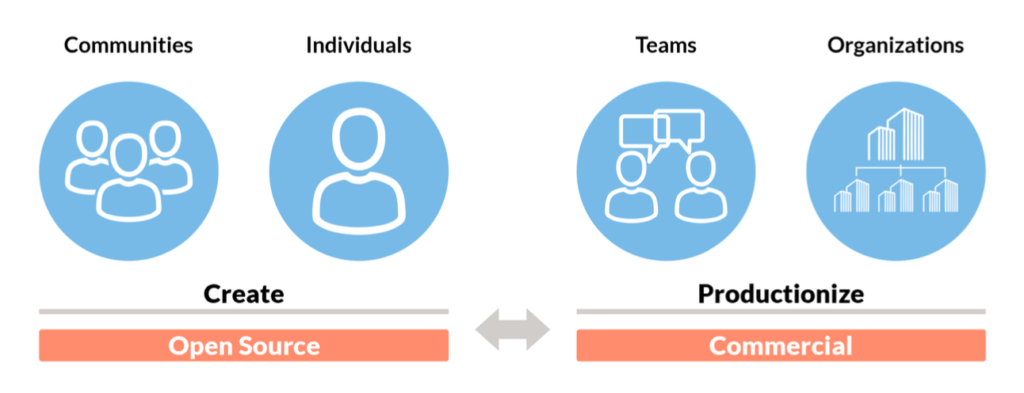
Fundamental Open-Source Business Models
Open-Core
Open-core companies are becoming well-grounded in ensuring that the commercial offering does not conflict with the open-core, but rather complements it. Essential functionality mustn’t be held back from the core product. Ensuring the success of the open-source is a precondition for the success of the commercial offering.
Professional Services
Early open-source companies often had a model built around professional services being offered to companies as paid support & consultancy. Chief among the challenges was the unpredictability of services revenue. Its margins were often low in comparison to product-based companies.
Hosting
It has enabled users to use infrastructural components without having to worry about the operational overhead of managing the infrastructure. The business of hosting among open-source companies is based upon charging a price lower than what it will cost users if they decide to host it themselves.
Marketplaces
Though still a new model, being an intermediary between two parties who interact with your product is a model being explored by open-source companies.
Ways To Make A Living With Open-Source Hardware
Sell Your Own Products
It is the most popular business model for open-source hardware creators. Since open-source is about taking from each other, much successful open-source hardware influences one another’s designs, from which they make their products.
Sell Products Made By Others
Many open-source hardware companies started off as retail shops selling products made by others before adding their own products.
Sell Products Made With Others
The idea behind open-source hardware is that products are designed as a collaborative effort between you and others.
Sell A Service
Some open-source hardware companies have their focus on providing services to other hardware companies.
Sell Your Expertise
Equipped with your expertise in a subject area, you can become a consultant, and get paid to advise other companies.
Sell Workshops
Organizing paid workshops to teach people how to build products can become a key activity for your organization. Some open-source hardware projects prefer to organize workshops for free, asking people only to buy the kit. Creating strong & delightful experiences is very important for this model to work.
Ask For Donations
You can add a donation button on your website, and perhaps also sell merchandise around your brand.
Become Part of Another Company
You could enter into a partnership with a bigger company for a manufacturing or distribution deal. Some open-source hardware projects even start as an offshoot from bigger companies.
Challenges of Open-Source Business Models
Security
The risk of a security breach is always present with the use of open-source software.
Updates
Open-source software often does not have any particular vendor releasing updates.
Lack of Customer Support
It means users have to seek out online forums to look for solutions to their problems with the software.
Compatibility
It may arise when some proprietary software is unable to work with open-source ones.
Training
Open-source software does not usually come with a suite of training resources.
Community & Licensing
It’s important that you choose the software have an active community, and you understand the content of the license and ensure it aligns with your business goals & objectives.
Confusing Complexity
Open-source software may have complex designs.
Not Realizing the Cost
Sometimes it takes a ton of time to manage open-source platforms.
Not Prioritizing A Policy
Your company should have a policy document guiding its use of software.
Learning Curve
Users who are not technologically inclined could have tons of issues learning how to use it.
Mystery Sources
Independent developers can make changes to the software, which could cause problems for your biz.
Seeing the Big Picture
The complex nature of software could make it hard for you to step back and take a look at the big picture.
Conclusion
Open-source is a sophisticated, multi-billion-dollar business industry. It has evolved over the decades into a business strategy with broad applicability. Businesses are being built around this idea. The most successful open-source software businesses have successfully employed a mix of all the discussed business models here.
The future of open-source software is bright and will play a bigger role in daily lives. This presents even bigger opportunities for businesses.