
What’s A Mental Model?
Mental models are strucutres that help us think. They make things easier to understand, so you can figure out what to do. They allow you to make good decisions for the long term, even when you don’t know everything about a situation. A mental model is: an explanation of someone’s though process about how something works in the real world.
A Lesson On Elementary, Worldly Wisdom
Building your latticeworks is a project that will last a lifetime. If you keep at it, you’ll always get better at understanding reality, making good decisions, and helping the people you care about. Here is a list of six types of mental models that help you make a good decision.
- Circle of Competence: when our egos, instead of our skills drive what we do, we have blind spots. When you’re honest about what you don’t know, you know where you’re weak and what you should improve. This helps you to make better decisions and get better results.
- First Principles Thinking: this is a way to help solve hard problems by separating the basic facts or ideas from any assumptions that are based on them. It’s sometimes called “reasoning from first principles”. What’s left are the most important things. If you know how something works at its most basic level, you can build on that knowledge to make something new.
- Second-order thinking: it means looking further ahead and thinking about the whole picture. It requires us to think about not only what we do and how it will affect us right now, but also how it will affect us in the future. If you don’t think about the second and third-order effects, disaster happens.
- The Map Is Not The Territory: reality isn’t like the map of reality. A map can be a picture of sth that no longer exists. This is important to remember as we try to find solutions to problems.
- Thought Experiments: they’re “imaginative devices used to probe the nature of things”. Many disciplines, including philosophy and physics, use thought experiments to investigate what’s known. They are effective because they help us learn from our past mistakes and avoid making them again.
- Probabilistic Thinking: It’s that a certain thing will happen by using math & logic, which is appropriate for getting better at making accurate decisions. It helps us figure out which outcomes are most likely in a world where each moment is made up of an infinite number of different events.
Why Mental Models Are Important?
Mental models influence how we comprehend information and how we react to it. Essentially, corporate leaders must understand why they believe the way they do and why they conduct themselves or react the way they do in given situations.
Mental Model Affects Your Business
Making smart investments & developing strategies based on business intelligence is likely related to a leader’s mental model. Business practices are based on standard mental models related to competing and constantly trying to improve capabilities and work processes in order to have a successful company.
The mental mode centered on increasing efficiency frequently revolves around cost-cutting, particularly in manufacturing or product development. It also can be applied to marketing & communications, sales, or accounting divisions.
Using Mental Models to Innovate in The Workforce
In the 80%-20% time guideline, workers are expected to follow standard management and leadership practices 80% of the time. Also, 20% of the company’s work won’t follow the usual procedures. This will give employees a chance to grow, be more creative, and try out different ways of running a business.
Another wise mental model that can help a company grow is to always focus on increasing innovation and discovering new ways to keep clients coming back. A business that is always coming up with new ideas will be more successful and keep customers coming back year after year for new & better products. This will ensure the profits remain strong, and stockholders remain satisfied.
The most common way for a firm to COLLAPSe is to continue doing business as usual. It means using management techniques that have been around for thousands of years and are based on basic forms of discipline. A corporation must avoid the mental model of exclusively following traditional management methodologies and instead use more innovative models that attempt to disrupt typical business processes and increase experimentation. This can result in increased success & profit in your firm.
The Core Mental Models
Circle of Competence
It’s a set of ideas came up with by Warren Buffett, it can be used as a strategy guide when making decisions about investments. To complete the circle of competence, one must first recognize their strong & weak points, and use the information strategically to their advantage.
First Principles
It’s one of the best ways to solve complicated problems and create creativity. It’s the ability to solve problems in ways only great thinkers can. The following are the steps of engaging in the first principles of thinking: Identify & challenge your assumptions (when facing a challenge, write down all your assumptions about it and think of the opposite sides of what you’ve written down); Separate the problem into its fundamental principles (what’re the basic elements of your problem? Asking potent questions is one way to identify); Create new solutions (mix the ingredients up in a new way to give you a perfect prepared cuisine, good ideas are crazy until they’re not).
Thought Experiment
The famous thought experiments: the Trolley Problem, the Veil of Ignorance, and the Prisoner’s Dilemma.
Probabilistic Thinking
Probabilistic thinking uses math, logic, beliefs, and knowledge to estimate the results of a specific outcome. Bayesian thinking is a form of statistical reasoning that involves the calculation and change of probabilities as new info becomes available to make possible predictions. Fat-tailed curves are types of probability distributions that are better than normal distributions at predicting how standard deviations will move. Asymmetries are probability estimators, and asymmetry is driven by over-optimistic & under-optimistic asymmetry.
Second-Order Thinking
Things are not always what they seem, when we try to solve one problem, we frequently create another that is even worse. Every choice we make, every step we take, and every problem we solve has long-term effects. Happiness is derived from solving problems. The only thing we can do is appropriately examine the long-term consequences of our decisions, which is what second-order think is all about.
Consider how your choices will affect your future decisions, not just the ones you have to make now. It’s a great way to helps us think beyond the first-order benefits and make better decisions in the long run by considering second-order or hidden consequences.
Second-order thinking involves thinking outside the box about the possible outcome of the problem you want to address. To use second-order thinking as a mental model, we have to leave our comfort zone. Questions to learn from send-order thinking: Which of my potential downsides are related to this choice? What kind of effects would my decision have on other people? What do other people think about the choice I’ve made? Why do I believe this is the best choice? Can I find more straightforward solutions?
Inversion
Inversion means to “rethink or reframe everything”. Example: keeping your eyes closed, try to visualize getting whatever it is that you want. The next step is to consider the exact opposite of your goal. The goal is to keep your mind on the result you want to achieve, apply inversion to your situation, and then work hard to avoid the things that are getting in your way.
By first thinking about the opposite of what want to happen, inversion lets us look at the issue without bias. Examples: How can I make it harder for myself to find a solution to this problem? What behaviors, actions, or circumstances might prohibit me from reaching my goal? Is there anything holding me back from achieving my goals? How am I going to mess this up?
Steps to use inversion: Write down your intuitive question; Think the exact opposite of what you just asked; Ask others to add to your ideas and confirm your assumptions; Make a strategy and action plan that avoids all the things you learned that could lead to failure.
Occam’s Razor
The simplest explanation is usually the most reliable. If you want to figure out what happened, come up with the simplest possible explanation. It takes an open mind to look for a better way to do things that is less complicated and doesn’t make as many assumptions.
Examples of Mental Models In Business
The Eisenhower Matrix
It’s the famous four quadrants: If something is both urgent and crucial, act right away; Give it to someone else if it is urgent but not crucial; If something is significant but not urgent, set a time shortly to do it; Eliminate it if it’s not crucial or urgent.
Network Effects
A product exhibits positive network effects when increased usage by any user increases the value of the product for other users (and sometimes all users). There are instances when negative network effects can occur, the above definition also denotes ‘positive’ network effects as about growth.
The Flywheel Effect
It has been expanded to encompass momentum, feedback loops, compounding returns, and direction in a single framework known as the “Flywheel Effect”.
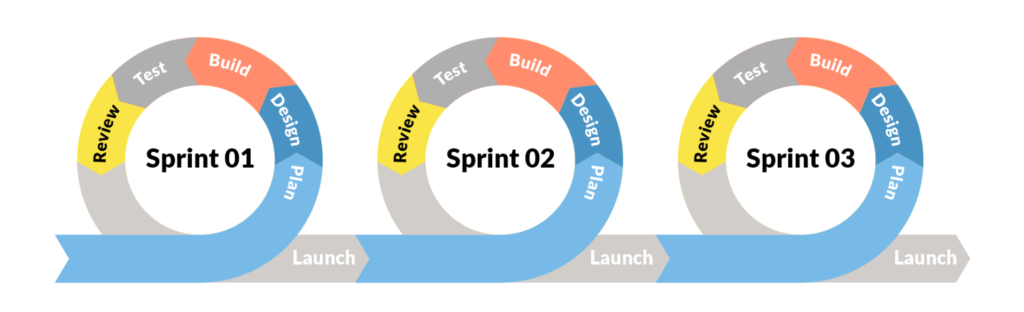
Agile Development
This model’s principles include adaptive planning, evolutionary development, early delivery, and continuous improvement, all while remaining flexible and responsive to change.
Forcing Functions
It’s an additional way to improve your decision-making, it can be any task, activity, or event that forces you to do something and make something happen. On the other hand, it acts as a catalyst for changing your default behavior in the future by aligning your short-term incentives with your long-term goals. The faster you can execute and act on business ideas, the faster you can gather feedback and iterate.
Regret Minimization
With regret minimization, you can look beyond the next few days about think about what will be best for you in the long run. What are the projects that you’ll regret not pursuing at the end of your career?
Bayes’ Theorem
It’s a simple way to incorporate probability thinking into our daily lives, which does not require knowing the exact math of probability calculation. More important is your ability and willingness to assign probabilities of truth and accuracy to anything you believe you know, and then to update those probabilities as new information comes in.
Confirmation Bias
People tend to look for and make sense of information that supports/confirms what they already believe. Accept that what you think is not always true, will help you avoid confirmation bias. Try to come up with different interpretations of what’s going on. Being more skeptical will cause you to dig deeper for objections, allowing you to set more realistic expectations before it’s too late.
Fundamental Attribution Error
It’s defined as a person’s tendency to attribute another person’s actions to their character/personality while attributing their own behavior to external situational factors beyond their control. In other words, you tend to give yourself a pass while holding others completely accountable for their actions.
Jealousy Tendency
It always involves a triangle of relationships involving the self, the partner, and the rival. As a result, when discussing jealousy, it’s critical to recognize its defining feature: the fear of losing sth to someone else.
Opportunity Costs
Every decision comes at the cost of another. Opportunity costs are not just monetary or financial expenses, they also include the true cost of lost output, wasted time, missed pleasure, and any other advantage that gives value.
Pareto Principle
It is also known as the 80/20 rule, which simply means a minority of inputs result in the majority of outputs. Learn to: Prioritize high values, Let go of perfection, and Ask simple questions.
Preferential Attachment
In a preferential attachment, the leader gets more resources than the other people in the group. They benefit even more from these resources. Using qualified and trained workers gets the job done, but it is also important to develop others who are coming up from behind, as no one is indispensable.
Redundancy
This is the process of making copies of important parts of a system so that there are backups and the chance of failure is lower. Simply put, it means adding backup procedures to a solution so that there is more than one way to reach the goal.
Comparative Advantage
It’s a theory that explains why businesses/nations/individuals can gain from trade, it means a country or company can produce a certain good/service at a lower cost than its trading partners.
Diversification
To lower risk, exposure, or volatility, diversification, in financial terms, entails investing in a variety of assets as opposed to allocating capital to just one. A portfolio that isn’t diversified may sometimes see strong growth, but it will be more vulnerable to changes in the market and to things that don’t happen as planned.
Economies of Scale
When a company’s production is efficient, costs can be spread out over a larger number of goods, which saves money. This is called ‘economies of scale’. The company can spread costs across a greater number of products thanks to its larger size and improved efficiency.
Efficient Market Hypothesis
It states that any information about the value of something will automatically adjust the price until the price matches what people think it is worth.
Game Theory
It’s the study of mathematical models of strategic interaction among rational decision-makers. In essence, game theory deals with the strategic interaction (strategy) between two or more participants (players) that produces a set of circumstances (game), leading to either a favorable or unfavorable outcome for the players.
Incentives (Reward & Punishment)
The concept of incentives holds that you can persuade people to take action by promising to reward them with something they want. It’s predicated on the notion that individuals act in their own best interests. People do things to get something good or to avoid something bad. The incentive theory states that your actions are directed toward gaining rewards.
Mental Models of Systems Thinking
Feedback Loops
When the outputs of a system are routed back as inputs as part of a certain chain of cause-and-effect that forms a circuit or loop. The system can then be said to feed back on itself. Positive & negative feedback loops exist in all complex systems, where A-B, then A-C,, with higher-order effects frequently arising from the loop’s continuous movement.
Equilibrium
A balance between one or more opposing forces is called equilibrium. As you might expect, there are various kinds of equilibrium. Static equilibrium is when a system is at rest, and dynamic equilibrium is when two or more forces are equally matched.
Bottlenecks
It’s a point at which a flow, whether it be of something tangible/intangible, is stopped, preventing it from continuing or moving. A bottleneck in the production of any good/service can be small but have a disproportionate effect if it is on the critical path, similar to a blocked drain.
Scale
Scaling is a subject that keeps coming up because it involves walking a fine line between having enough capacity to meet user demand and not having enough capacity to leave our servers idle.
Margin or safety
According to the investing principle known as the “margin of safety”, a stock should only be bought when its market price is significantly lower than its intrinsic value. It means we should give ourselves room for error or failure.
Churn
It’s well known to subscription services and insurance companies, that a certain number of customers must be lost and replaced. According to the “Red Queen Effect” model, remaining motionless is the same as losing. Many business and human systems exhibit churn: a constant figure disappears and needs to be replaced before any additional figures can be added.
Critical Mass
In social dynamics, critical mass is the number of people who adopt an innovation in a social system at a rate that is high enough to support further growth. The moment a business achieves self-sufficiency and financial viability in the business world is known as critical mass.
Law of Diminishing Returns
The law of diminishing returns says that after a certain point, adding more investment, effort, or skill doesn’t make the rate of profit, production, or benefit growth in the same way.