
What is a competitive analysis?
It is a key component of any successful business strategy. It involves conducting an evaluation of the major players in your industry to get a better understanding of their products, sales techniques, and promotional strategies. So you can gain insight into where there are opportunities for improvement on growth in your organization.
It also involves identifying the top competitors in your industry using market research techniques such as surveys or reviews. The comparison process should cover everything from pricing structures to customer service initiatives and product features.
Factors your competitor analysis should include
Feature Matrix
It involves examining each product or service offered by competitors to determine what features they provide and how they compare from one to another. It is a great way of visualizing the differences between products in a side-by-side comparison, allowing businesses to make more informed decisions about the best fit for their customer base.
When creating a feature matrix, the following factors should be included: feature type, description, benefits or effects, usability or convenience factor, pricing, customization options, security, privacy policies, support services, user experience design, platforms/devices supported, speed/bandwidth reliability, data storage availability, etc.
In essence, feature matrix analysis allows companies to accurately determine which features are most important for their target market so that they can invest appropriately.
Market Share Percentage
It is an essential factor to include in your competitor analysis because it can provide valuable insights into the competitive landscape of your industry. You will be able to see which competitors are dominating the market and which ones are struggling. It helps you to identify potential threats from leading competitors, as well as opportunities for growth from smaller players in the market.
Focus 80% of your attention on companies with comparable market shares and 20% of your attention on top competitors. This will help you better understand how they are succeeding in your industry, while also allowing you to remain competitive.
Pricing
Companies should look at not only each individual item’s price but also the aggregate price point for an entire purchase. First, identify competitors’ prices for their respective products or services, including any special offers, discounts, or bundles. Compare these prices to those of other markets, both within and outside your industry, to get an overall sense of how competitively priced your competitors’ offerings are. Second, look out for pricing differences based on customer type: loyalty programs, subscription options, or membership deals associated with discounted rates. How do these compare to standard packaged solutions? Finally, study how competitors choose to display their prices and gauge how much thought they put into making it accessible and understandable for customers.
Effective competitor analysis requires scrutinizing pricing trends and systems across various markets to discern where each one stands in terms of quality vs quantity, as well as customer value perception. All those factors give you a stronger insight into which strategies would best suit your business model and ensure that you have all the necessary info before taking action in this aspect of company operations.
Marketing
Except for the price, product, and service comparisons, it is important to consider the bigger picture of each competitor’s marketing plan. Factors such as online presence should be taken into account: website design, website content, SEO, SNS, etc.
Differentiators
It helps to identify what makes your competitors unique and how their offerings differ from yours. It can range from tangible competitive advantages like cost and product quality to intangible competitive advantages like customer service or brand recognition.
A way to evaluate a competitor’s differentiators is by analyzing what they advertise as their best qualities. The info can be found on the website, printed materials, and advertisement campaigns. Take time to compare these attributes with your own company’s differentiators. It is also useful to understand why customers choose to purchase from a competitor instead of you.
Strengths
Product quality: do online reviews, consumer feedback, or sales figures suggest that your competitors have a superior product? Are they offering more features, higher quality materials, or better performance than you? Is there something you can do to match or surpass this level of quality?
Brand awareness and recognition: ask customers about their perceptions of each brand – what brands come to mind when they think about buying in your sector? Look into industry awards – did any of your competitors win recognition from trade organizations or consumer groups recently?
Test competitor’s products: it gives insight into areas where another brand may be performing better – whether it is a more user-friendly design interface, faster delivery times, or additional services such as warranties and return policies included at no extra cost.
Weaknesses
A comprehensive analysis should start by evaluating each competitor’s online presence: is their website outdated? do they lack an online store? are they lagging in terms of SNS marketing? By asking yourself these questions, you can begin to assess where they may be falling behind and how to fill those gaps with your own strategy.
Geography
The business location can provide insight into how they interact with customers, as well as market trends in different regions. It is beneficial for understanding the customer base and target markets. Companies with brick-and-mortar locations may have a large presence in certain regions, but limited reach elsewhere. Certain products may be extremely popular in one area while never quite catching on elsewhere.
Culture
Objectives: understanding what a competitor’s goals are will help you identify potential opportunities or threats and better understand what strategies may be employed against you. Examining any long-term strategies or initiatives the company has planned will give you a better idea of where they intend to go in the industry.
Employee satisfaction: employee reviews provide a great insight into the overall atmosphere within a certain organization and can indicate whether employees feel empowered or frustrated in their roles.
Environment: examining close competitors’ work environments is important when assessing their overall cultural identity. For example: perks, flexible working hours, outdoor recreation activities, etc.
History: Looking back on history can give you invaluable insights into how successful companies have adapted over time according to changes in trends and consumer demand shifts. Does the business focus heavily on innovation, or does it stick with traditional marketing techniques? Studying past successes can enable your company to adapt accordingly so as not to lose out on current opportunities.
Customer Reviews
It provides insights into what customers think of the product/service your competitors offer and is often an invaluable source of information. It helps you uncover any issues with the competitor’s offering that may have gone unnoticed otherwise, and provide valuable insights into how well your competitor is doing in terms of meeting customer expectations.
Benefits of Carrying Out a Competitive Analysis
Identify Your Business’s Strengths and Weaknesses
You can get a clearer picture of what sets your company apart from them, by looking at your competitor’s products, services, prices, marketing strategies, customer service policies, and more. You will also be able to see which areas need improvement within your own business.
A competitive analysis provides valuable insight into customer opinions about both your competitors and your own business. It lets you know what customers think is most important when evaluating potential purchases or services.
Understand Your Market
Identify your competitors: identify who your competitors are, analyze their strengths and weaknesses, and better understand how they operate in the market. Knowing your competition allows you to build strategies to differentiate yourself from them, as well as provide ideas for products & campaigns.
Analyze their strategies: analyzing your competitor’s strategies gives you a better understanding of what works and what does not work in terms of customer engagement & brand awareness. Knowing those details will enable your company to position itself more effectively compared to its competitors.
Monitor positioning changes: it allows companies to stay ahead of the competition by capitalizing on any shifts that may have gone unnoticed. It includes new products/pricing structures designed specifically for gaining traction within the target audience or market segmentation opportunities that have been created by those same competitors previously unaware of them.
Uncover new opportunities: the analysis provides insights into areas where customers feel underserved by current offerings. It can be an indicator that there’s potential to expand services or create new products/services based on unmet customer needs, which can offer real potential for growth within the marketplace at large.
Enhance customer retention: it provides insight into what others are doing in terms of targeting specific customers with certain offers, it gives organizations scope for developing tailored customer retention initiatives based on feedback received during research. The insights can provide invaluable data about customer pain points/preferences/expectations around service levels, all of which feed into ensuring existing customers remain loyal over time, thus maximizing profitability.
Spot Industry Trends
Competitive analysis enables you to identify trends and understand where your competitors are heading, what tactics they are using, and how the market is changing. Besides, it helps you gain insight into market dynamics, such as emerging tech and customer demands.
The knowledge gives you an edge when it comes to designing better-targeted campaigns or optimizing product features based on customer feedback. Competitor analysis allows businesses to stay one step ahead of changes that can drastically impact their bottom line – and spot industry trends before they become widespread enough to affect the entire sector.
Set Benchmarks for Future Growth
By studying both established companies in your industry and new entrants into the market, you can gain valuable insights into what success looks like in your industry. Established companies provide a model of what works: from which markets they target to how they position themselves in their sector, while new entrants offer an indication of up-and-coming trends that you may need to watch out for.
Regular competitor reviews allow businesses to keep abreast of rivals’ activities across different areas, including marketing campaigns, pricing movements, customer service improvements implemented, product updates launched, etc. Setting standards for improvement that help direct internal efforts toward process optimization – ultimately leading to increased efficiencies and cost savings.
Competitive Analysis Strategies
SWOT
Strengths
It is an integral part of a SWOT analysis and relates to the INTERNAL aspects of a business, which refers to factors that a business does well in comparison to its competition – characteristics that give it an advantage, such as skills/resources/capabilities, etc. Strengths help companies identify potential chances for further growth, as they allow organizations to recognize their areas of expertise and focus on exploiting those strengths for a competitive advantage.
Weaknesses
It refers to INTERNAL factors that impede the company’s ability to achieve success. There are areas of the business that need improvement for the firm to be competitive and successful, such as weakness in brand identity/high turnover rates/debt/insufficient supply chain/low levels of investment, etc. Weakness can often be seen more easily from an outsider’s perspective than from those within the organization itself. Taking action on these identified weaknesses is important because it may offer a competitive advantage over organizations that have not addressed them yet.
Opportunities
It refers to EXTERNAL factors that present a company with the opportunity of achieving a competitive advantage, which includes governmental regulations/emerging markets/customer needs/technological advancements. It is used to assess such opportunities and how they can contribute to the profitability, performance, sustainability, and competitiveness of an organization.
Threats
It refers to EXTERNAL factors that could possibly affect the goals of a company negatively, which can be short-term or long-term. They must be identified before strategies can be implemented to mitigate them. Commonly, it includes natural disasters/economic events/rising costs/changes in customer preference, new regulations/technological disruption, etc. Organizations must identify these threats as early as possible to take appropriate action and minimize their impact.
A thorough SWOT analysis allows companies to proactively monitor changes in the market landscape, identify emerging trends, and develop plans accordingly to protect their operations from harm caused by external threats.
When should you perform a SWOT analysis?
First: when you want to make an informed decision about a business action, whether that be adding a new product or revamping your internal policies. A SWOT analysis will give you insight into how this move would impact each area of your business.
Second: at designated intervals throughout the year, businesses can change quickly over time, having scheduled intervals where you assess your organization’s current state ensures the major changes don’t slip through the cracks. The SWOT can be proceeded monthly or quarterly.
Third: when there is significant change within the company/industry, it is important to review operations via a SWOT review so that any repercussions of such changes can be identified early on and mitigated before more serious damage occurs.
Finally: when new ideas are brought forward – particularly ideas outside of coring offerings – they must be evaluated thoroughly.
How to do a SWOT Analysis?
Determine your objective: It is the 1st step to a successful SWOT analysis. With a target goal in mind, it will be easier to focus your efforts and give more meaning to the exercise results.
Gather resources: it refers to data & personnel, should be identified prior to the beginning of the analysis.
Data sources: the output relies heavily on reliable internal and external data sources, such as financial statements, industry reports, customer surveys, competitor research, etc.
Personnel: from sales staff, manufacturing staff, engineers/technicians/consultants with better insights into internal operations. Involving those individuals ensures more diverse contributions are made towards identifying potential opportunities/threats within each are.
Prioritization: priority must be placed on gathering information for use in forming a complete picture of key areas related to SWOT. Careful consideration needs to be taken into account when prioritizing the step – timing is important if there are deadlines.
Compile Ideas: make a list of items for each of its 4 components, there is no right/wrong answer for this section, as all items listed can be evaluated later on to determine their usefulness. The goal should involve coming up with as many possible items as possible to have an extensive list across all categories.
Refine Findings: it involves taking the ideas and info gathered from the previous steps & focusing on only the most relevant or pressing ones to focus on. The goal of this stage is to identify which issues or opportunities need to be addressed first that will have the greatest effect on helping reach the desired outcome. It is important to remain focused on long-term goals rather than short-term wins so that strategies can be aligned accordingly.
Developing Strategy: This involves synthesizing the info collected in the SWOT analysis and developing a plan of action based on it. Team members take all the SWOT they identified during the assessment and brainstorm ways to address each one to form a strategic plan. They review each item in light of the company’s original objective – deciding whether to release a new product or not – and use the goal as the guiding light for their strategy.
Benefits of SWOT Analysis
It makes complex problems more manageable: the primary benefit of a SWOT analysis is that it offers a more manageable approach by breaking large problems down into smaller ones. By simplifying the data into SWOT – areas of hope or concern – one can see how various components might affect the decision while also understanding what other considerations need to go into affecting change or creating growth.
It requires external consideration: it forces a company to think beyond its immediate environment and consider larger trends/events that may affect its decisions of operations. This helps companies create proactive plans for dealing with potential issues so that they don’t feel caught off guard if something unexpected occurs outside their realm of influence.
It can be applied to almost every business question: it can analyze anything from an individual’s career to a full product line, changes in brand strategy, or geographical expansion plans – basically, from a small microcosmic level up to large macrocosmic levels.
It leverages different data sources: it allows businesses to gain insights into their competitive landscape, customer base, etc. The use of multiple data sources helps to reduce bias when conducting a SWOT analysis since it provides an overall view of the organization within its given environment.
It may not be overly costly to prepare: it can be completed with little outside assistance or consulting. It allows companies to quickly pinpoint improvement opportunities without developing lengthy reports and detailed documents, which may require many resources.
Strategic Group Analysis
What is a Strategic Group
It is a method used by organizations to analyze and determine the competitive landscape in their industry, which entails recognizing a cluster of firms that share comparable features, such as cost structure/range of products & services/official organization/processes/preferences, and perceptions of consumers. Companies belonging to the same strategic group typically compete for the same customers with similar strategies and resources.
How to Conduct a Strategic Group Analysis
Make a list of direct competitors: it involves identifying companies in the same industry/market segment as the company one is representing. It includes assessing the inventory of the products/services that the business has, the target demographic and customer base, and their standing with consumers. A key step in this process is to determine which specific organizations represent challenging obstacles that may impede the success of your own business if not addressed.
Distinguish between companies on the list: it allows you to understand which groups of competitors are more competitive than others and provides insight into why they might be doing better.
Organize the companies on a map: it is an effective way to understand and visualize the competitive positions of each company.
Evaluate the data on the analysis: it is important to consider the overall market & potential opportunities that could arise as a result of your findings. Examine the size of each competitor’s market share to determine which ones dominate the sector. Analyze the competitive advantages of each individual company to ascertain where your brand stands, and compare each attribute between different competitors to see who has the edge over their rivals – it gives you an idea of what makes them successful and how you can emulate some aspects while making yours even better than theirs.
Benefits of a Strategic Group Analysis
Discover new business opportunities: it helps you discover markets that have not yet been tapped into, enabling you to reach a wider consumer base than your competitors. Companies will benefit from first-to-make in an emerging market, as it can establish them as the front-runners in terms of profits, name recall, and market share.
Learn from competitors’ mistakes: you can avoid the same issues in your own project. The analysis offers insight into why the failure occurred, what contributed to it, and any changes in the market that ought to be taken into consideration when plotting future projects.
Evaluate the success of competitors: using the analysis to examine how a competitor’s approach proved successful. It also provides insight into when it might make sense to replicate an existing strategy or try something new.
Porter’s Five Forces
It is a helpful tool for understanding the underlying dynamics of any industry. It involves [the threat of new entrants, buyer bargaining power, supplier bargaining power, the threat of substitution, and the intensity of rivalry among firms].
Differences between Five Forces and SWOT
Five Forces are utilized to assess the competitive environment in an industry, it considers five key factors and seeks to determine how much control each group has within the industry and how likely it is that new players will enter the market due to economic conditions or other barriers. SWOT looks more deeply at an organization’s internal potential.
5 Forces provides data on macro-level competition, and SWOT provides insight into microenvironmental variables that impact firms operating therein.
Five Components of Five Forces
Competitive Rivalry: it is the most important of 5 forces, and reflects the level of competition between companies in a particular industry. The degree of rivalry amongst competitors is often affected by factors such as market share/product differentiation/market size/growth, fixed costs, entry barriers, ad expenses, and concentration ratio. All those factors reflect the competition intensity between companies within an industry.
The Potential of New Entrants into an industry: it relates to a company’s ability to ward off potential rivals and how easy it may be for newcomers to enter the industry & compete effectively with existing players. Knowing which characteristics are needed to enter into the market and barriers that could prevent others from entering, can help companies determine their competitive edge over others in their field.
Power of Suppliers: It refers to how easily a supplier can increase their prices or reduce the quality of their product. How much power suppliers have depends on how easy it is for a business to switch between them.
Power of Customers: buyers can affect prices and other elements of a product or service within an industry. It is important to look at the number of buyers compared to suppliers as well as other factors, such as customers’ switching costs & bargaining leverage related to the size of orders or volume discounts offered by suppliers.
Threat of Substitutes: it shows how vulnerable a business may be to new competitors entering the market. It is especially relevant when disruptive technologies enter the industry and make older methods obsolete.
Perceptual Mapping
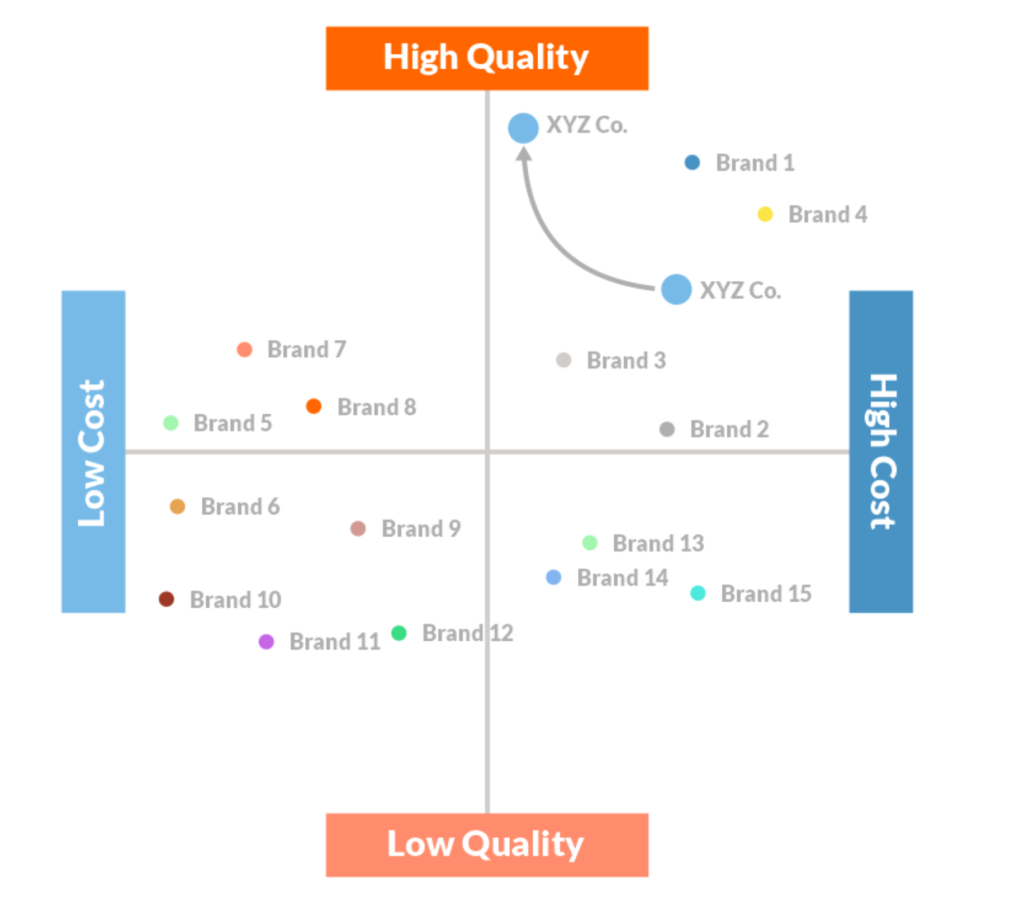
It is a tool used by businesses to understand their customers’ feelings/thoughts/perceptions regarding their products/services/competition/positioning. It visually depicts how customers perceive and evaluate different aspects of a company’s offerings about each other.
It allows businesses to refine their messaging and product offerings to better meet consumer needs and gain an edge over competitors.
WHY do Perceptual Mapping?
Insight into customers: It provides you insight into your customers’ thoughts and opinions about your company/product/service/relationship with competitors. The map gives you a visual representation of how they perceive the differences between different brands. Moreover, it identifies which features differentiate it from competitors and appeal to certain customer segments. It also helps identify new opportunities for growth or untapped sources of revenue by discovering who is not buying from you now but would potentially do so if targeted differently on pricing.
Perceptions tracking: it involves gathering feedback from customers to track how their perception of your brand/product/service changes over time. This type of tracking can provide valuable insight into how customers view you compared to competitors and help you understand where improvements can be made.
Market research on competitors: it helps you better understand where your competitors are placed in the market and how your products compare to theirs. The information can provide useful insight into a company’s competitive advantage or disadvantage, allowing you to target areas where you have an edge over others in the market.
Brand Repositioning: This entails changing the perception that customers have of a brand. It involves shifting customer beliefs, values, and perceptions about a company’s product/service. Perceptual maps can be used to help businesses gain insights into how consumers view their brands in comparison to competitors. It helps companies decide on strategies for creating new associations or adjusting existing ones with their brand.
Development of new products: A perceptual map helps you identify customer preferences and reveal the opportunities for differentiating products in the market, forecasting demand for a potential product before mass production begins. Then it becomes easier to make decisions regarding how much to produce and when to launch it for maximum effect. The map can also assist in assessing how competitors may be impacted and will react to your new product entering the market.
Who can use a perceptual map?
It is a useful tool for any business that provides a service and wants to better understand the perceptions of its customers. Marketing teams/brand managers in competitive industries can also utilize perceptual maps to evaluate customer feelings about different products/services offered within the same sector. The perceptual map gives organizations an inside look at how their offerings are perceived by potential customers – info can be priceless when making important decisions.
How to Create a Perceptual Map
Pick your parameters: it is important to consider your own business objectives as well as what attributes are important in the market. This means taking into account customer pain points and the attributes that lead to success in your industry. Additionally, research or focus groups can be very beneficial in determining which parameters would make up an effective perceptual map.
Define your competitors: competitive analysis should be conducted to determine which companies are direct and indirect competitors. Through the analysis, you can gain knowledge of your strong points and weaknesses, where your target market is, what interests/choices they have, how the competitor’s product or service differs from yours, and any customer reviews they have received. It is best practice to include at least 10 different competitors in perceptual maps to gain the most accurate visualization of one’s position relative to them.
Place your competitors: adding each competitor onto the perceptual map is essential to understanding consumer perception of the brand in comparison to its competitors. It helps to have insights from competitive analysis before drafting the map, as it will provide valuable info when deciding where each competitor should be placed. Using insights from your competitive analysis, draw out your map and add your competitors where you think they belong. Start by plotting each competitor according to their ranking from your parameters. Placing them close together can indicate that there is a level of similarity between these particular products/services/brands, but replacing them further apart could signify an extreme difference between them.
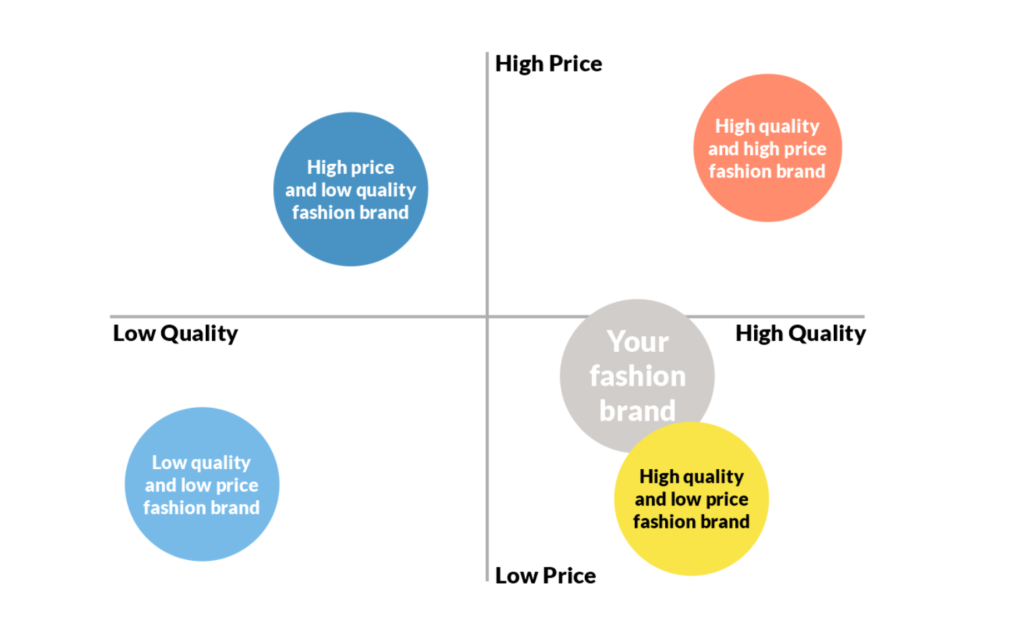
Share your map: it is an important part of using the map as a tool for gaining further insights into consumer attitudes toward your brand or product.
BCG Matrix (Growth Share Matrix)
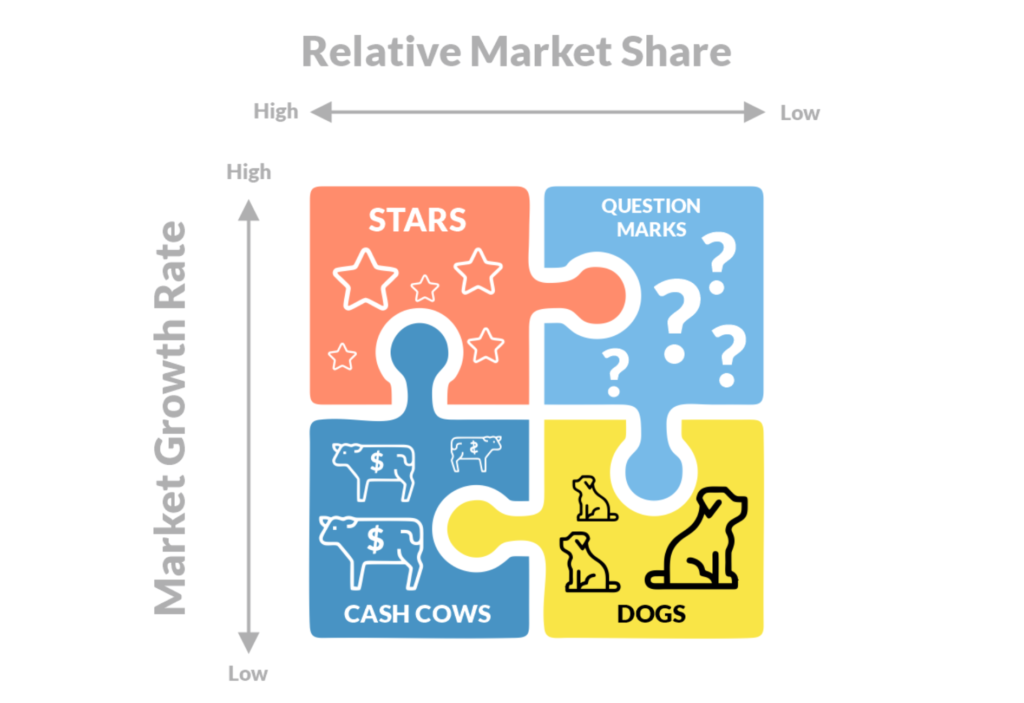
BCG Matrix (Boston Consulting Group Matrix), it is used as a tool to help businesses evaluate their product/service portfolios, to decide which products should be invested in and where resources should be allocated across a business’ product divisions. It is based on two main indicators of performance: Market share relative to its competitors and Market growth rate. It classifies each product/service into one of these four categories – Stars/Cash Cows/Question Marks/Dogs – using those two criteria, based on their current level of success.
Understanding a BCG Growth-Share Matrix
Stars
Star products are those in high-growth markets and make up a sizable portion of the market. It brings in substantial revenue yet requires a considerable expenditure of funds. Stars typically experience rapid growth in sales and require a great deal of cash to fund this growth (advertising/research/development), etc. due to their need to maintain their competitive edge and dominance in the market.
In addition, with established competitors, it is important for them to continuously innovate to remain ahead. Stars tend to be quite costly investments for companies, as they often allocate huge amounts of resources to these products.
Cash Cows
Cash Cows are products that are in low-growth markets with relatively large market share. It provides the company with higher returns than the market’s growth rate. The products benefit from a steady cash flow, and they often do not require much investment to maintain their current performance. A product’s value can be determined by its predictability, as cash cows tend to have highly predictable cash flows.
Question Marks
Question marks are products and/or business units with a high market growth rate relative to their current market share. They have a high market growth rate yet possess a low or weak market share compared to other competitors in their sector. Frequent monitoring from management is required.
Dogs
Dog is a product with a low market share and is growing at a low rate. It has little to no contribution towards cash generation for the company due to its lack of market share and minimal growth potential. The products can be thought of as money pits, trapping company funds without providing much return – resulting in suitability for divestment or liquidation.
Stars Quadrant
It includes products/business units with the greatest market share and most cash generated. Monopolies and first-to-market products may also be categorized as stars in certain scenarios. The challenge is: that despite the growth rate, Star may consume large amounts of money too. Although there is a lot of money coming in, an equal amount is going out as well, making the net revenue negligibly small.
Investment in stars requires careful consideration and great strategy. With proper planning, companies can make sure that their resources are being used wisely on those projects to ensure their success over time. If a STAR product can sustain its success for long enough without slowing down, it could eventually become a cash cow when the market slows down due to its high market share and profitability until then.
Cash Cows Quadrant
It is the most desirable of the 4 quadrants in the matrix, which represents products/services with a high market share but low growth prospects. Those products are already well established and typically generate more cash than they consume. It offers a significant degree of stability and security for an organization’s bottom line because they have such well-established footholds in their respective markets that further investments are not needed to maintain them.
Question Marks Quadrant
It is for business units/products that have high growth prospects but a low market share. It consumes a lot of cash and brings little in return, making them net losers for the company. It needs to be closely monitored, as they can quickly turn into either stars or dogs. Companies should invest resources in these parts of the business if there is potential for rapid profits, or sell off these parts if they do not have the potential.
It is risky and requires significant resources, yet they have the potential to offer higher returns than other quadrants.
Dogs
It is used to identify products with a low market share and low growth rates. The units lack business performance and cash flow contributions. It can range from small side businesses that bring little to no net income and growth opportunities, all the way up to large-scale business units within an organization that consumes most of its cash flow without offering any return on investment. Those companies are typically stagnant in terms of performance and earnings.
When to use a BCG Matrix
It is particularly useful for marketing/project management/strategic management as it helps companies better understand their business portfolio. Generally, it is employed during the early stages of creating a strategy for a marketing campaign or project.
How to use the BCG Maxtrix
Stars
It refers to products that have a high market share in a rapidly growing market.
To take advantage of this, businesses must invest heavily in developing innovative products that can stand out from the competition. It may be expensive but is necessary for sustained success because stars typically occupy product life cycles that extend for long periods. If successful, those STARS can even become cash cows within the marketplace when their respective categories mature.
Cash Cows
It is a product/service that earns an exceptional amount of money relative to its investments and other costs, which is the crown jewel of a business portfolio – it earns revenue while needing very little investment and should be managed to guarantee continued profits and cash flow.
Cash cows should capitalize on their sales potential and make the most of their current size to boost profits. It is important to recognize when these opportunities present themselves so as not to neglect them. It will help ensure consistent profitability throughout the years ahead.
Question Marks
It refers to businesses/products that have high growth rates but occupy a small market share. They are also known as ‘problem children’, and most businesses start off as one of these. Though they have the potential to reach great heights, it require huge investments to capture/protect their market share.
It is a risky option when investing, not every investment will lead them to become stars and eventually cash cows. Careful consideration is essential before investing in question marks since this kind of decision can make or break the entire business.
Dogs
It refers to a product that has a relatively low market share in a low-growth or declining industry. Dogs face cost disadvantages due to their limited scale of economies, which makes it difficult for them to return on investments. They are also typically situated at a declining stage of the product life cycle, making them less attractive for companies and investors looking for promising opportunities.
Companies should look at ways of minimizing the number of dogs within their portfolios by optimizing current operations and getting rid of non-value-adding activities/features that those products possess. Companies should also reposition their offerings in terms of pricing strategy or sell off these businesses together if there are no prospects for gaining market share. It will help ensure that resources are being allocated efficiently with minimal risk.
How to Create a BCG Matrix?
Choose the Product
No matter what type of product is selected to be evaluated – individual products within a particular business unit, several branded lines associated with a particular parent company, or all items sold under one company – care should be taken to ensure an accurate reflection of their relative market performance and potential to attracts sufficient attention during the development process and beyond.
Any choice selected should reflect both current realities in terms of consumer engagement patterns, as well as potential upsides inherent within any specific product line consumers may respond favorably toward, giving appropriate marketing strategies established by key decision-makers within any organization undertaking such analyses. Take into account customer reviews from online sources, including direct feedback, and add them into consideration so that only valuable information makes its way onto the analytics dashboard before starting your own BCG matrix process.
Define the Market
It is important to consider all factors that distinguish different types of products and their respective markets. It helps to identify potential submarkets within the larger consumer segment, which can be further explored and classified accordingly.
Considering various aspects related to specific product types helps ensure a more comprehensive analysis, which is useful for better understanding business strategies and developing effective decision-making processes going forward.
Calculate the Relative Market Share
Comparing the sales of your product to your rival’s product in a given year, and can be measured either in terms of revenue or unit volume. It is important to remember when discussing specific markets or industries with different global players that there may not be a single “leading rival”.
Find Out the Market Growth Rate
It demonstrates the potential opportunities for firms to expand their market share. The info can be found through free online sources, such as business journals & financial reports of leading firms in the industry.
Markets with high growth are ones where the total market share available is expanding rapidly. They represent good opportunities for companies to make money and develop competitively. Finding out what percentage of increments each competitor has experienced over time can provide corporations with key insights into how well competitors are doing relative to them & if any strategies need to be implemented to stay ahead in terms of customer demands or preferences.
Draw the Circles on a Matrix
The X-axis should represent relative market share & the Y-axis should reflect the industry growth rate.
Drawing a circle whose size roughly corresponds to the proportion of revenue it generates – the greater a product’s revenue stream, the larger its circle will be. It may also be useful to list out all your units, brands, and products in order from the highest relative market share to the lowest along the bottom side of the matrix so that it’s easier for viewers to quickly identify the industry leader.
Limits of BCG Matrix
It only uses TWO dimensions, relative market share & market growth rate, to measure the performance of products or business units. Those two aspects provide insight into a business’s competitive standing, they are not the only indicators of profitability/popularity/performance.
The BCG doesn’t take into consideration the potential benefits of collaboration (synergy) between brands. One brand can enhance another in terms of brand recognition or general awareness, which may result in greater profits than each individual unit could generate on its own.
Marketing Mix/7 PS Model
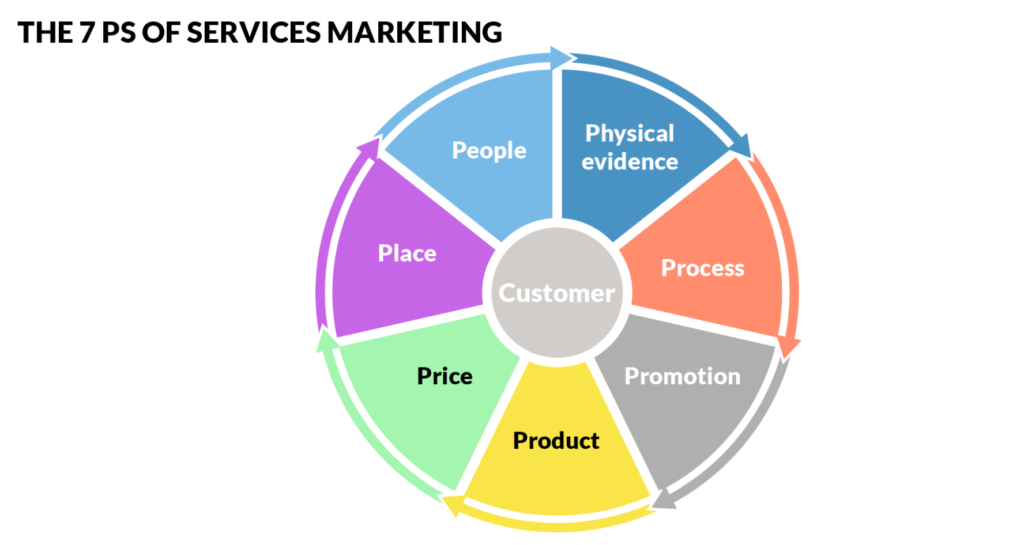
It is a comprehensive framework for designing and implementing a successful overall marketing strategy. It helps firms identify their key competitors, as well as recognize opportunities to create or improve their strategies. It consists of seven distinct Ps – Product, Price, Place (distribution), Promotion, People (staff), Process, and Physical Evidence. The first four are CORE components of a complete marketing mix.
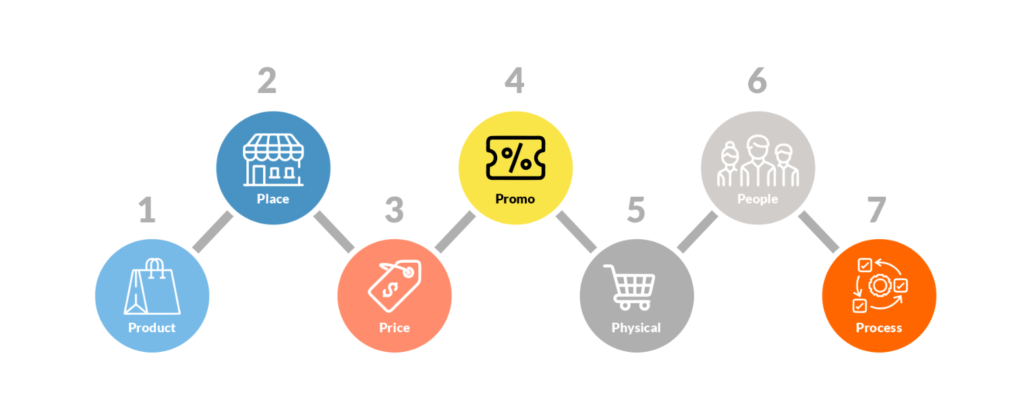
When to use it?
It depends on individual business goals. It is important to note that this framework can provide valuable insight at any stage of the marketing cycle, it can be most efficient when used in specific circumstances.
The 7Ps can help you draft a clear value proposition to analyze the competition to determine where they are lacking and what they offer that could become part of your unique value offering. If an organization is revamping its strategy or introducing new elements into its current approach, this model can help it identify opportunities to differentiate itself from competitors in a meaningful way.
In addition, the 7Ps can be used when there is new tech/shifts in consumer trends & behaviors can also be beneficial as businesses strive to adapt quickly and establish themselves among the target audience.
How to use the 7Ps in competitive analysis
Products/Services
It involves looking at the types of products/services offered by competitors. Evaluate what they are offering to consumers, how they are packaged and presented, and how they match up to your products or services. Are there similarities/differences you can leverage in any way?
It is important to compare technical specifications/price/quality/market position/overall design, as well as extra features such as after-sale support or maintenance services/warranties, etc. Keep an eye on competitors’ attendance at conferences/trade shows to see their products/technologies/innovations, and any new patents they have in the market.
Price/Fees
To properly analyze competitor pricing strategies and assess the competitive landscape, it is important to ask questions such as: What are the competitor’s charging standards? Are they offering discounts, bundled offers, or packages? Do they have special financing options? By understanding all these you can establish your own pricing strategy, and ensure your price remains competitive.
Many companies use a price-setting strategy called ‘value-based pricing’ when setting prices that reflect not just the cost of goods sold, but also their perceived value in comparison to competing providers. Establishing an appropriate pricing model allows you to maximize revenue while staying profitable and attaining sustainable market share amongst industry rivals.
Place/Access
It is a component that considers the actual locations where potential customers can purchase the products/services. It involves physical stores and websites where customers can make a purchase. Knowing where customers can buy gives you insight into their reach and influence within the market. It could also point to ways you can potentially expand your customer access points.
For stores/outlets, location/visibility are essential elements in attracting customers. For websites, user experience design should be carefully considered when selling products through digital channels. It is important that potential buyers can easily find the goods without complicated navigation, different payment terms & offers may lure interested individuals into completing a purchase with you rather than your competitors.
Promotion
It refers to the methods/channels used by your competitors to market their products/services. Companies use those tactics to make themselves seen, build an audience, and increase sales. When using the 7Ps in competitive analysis, it is critical to assess how your competitors are promoting the biz.
Consider what methods your competitors are using to promote: do they have paid ads or SNS promo? do they post updates frequently? do they employ SEO strategies? Knowing key metrics such as website visits, and impressions generated from ads & SNS can help you determine which techniques are working.
Investigating who your competitors’ target audience is: knowing this provides valuable insights into the messages you should be presenting about your product/service and the type of targeting that would have maximum success. Online websites and brick-and-mortar stores are critical.
Physical Evidence
It refers to tangible products/services that help signal to customers the quality of the experience. The physical evidence can range from something as simple as a store’s layout, staff uniforms, and printed menus for a restaurant to product warranties/certs for manufacturers.
In manufacturing, product warranties are important physical evidence components that signal quality. A warranty serves as an assurance that a company stands behind its products/services, which helps demonstrate trustworthiness between customer & business, and also shows that manufacturers believe in their products enough to guarantee them against defects or mishaps of any kind.
Processes
It refers to the ways a company organizes activities, operations, and processes so that it can deliver its product/service to its customers. Examining the organizational structure, goods packaging, distribution process, customer support, and any other processes associated with providing a service or product is crucial. High-quality processes ensure that customers receive the products quickly and effectively with minimal frustration/confusion about how to use them properly.
People
To assess customer satisfaction with competitors’ customer service, it is critical to evaluate reviews from customers about their experiences and whether they had negative reviews indicating a bad experience or not. It is also key to consider a company’s or brand’s reputation. It is important to review existing customer feedback so that you can identify areas of weakness where your offering may be able to better meet customer needs and how these weaknesses could hinder competitors’ ability to retain customers. Customer feedback should be analyzed carefully, as it can provide valuable insights into how products and services are perceived in the market.
When should we do a Competitor Analysis?
A competitor analysis should be used at each stage of the business lifecycle.
Starting a Business
It provides you an understanding of the industry that you plan to enter or disrupt. Knowing who else is entering the space as well as what big players are already established in the market can help inform decisions about strategy, product development, and marketing.
It is essential to have a full understanding of who your direct competitors are, the leading players in the competitive field, and any possible competitors from related industries, as investors will probably wish to know what rivals are present.
Competitor analysis should also include an evaluation of pricing models, including costs associated with the main features/products offered by each player, to determine where they stand on price points compared to one another.
Launching a New Product/Service
By understanding what your competitors are currently offering, you can create something uniquely different from anything else on the market. It will help you determine how to craft effective messaging and marketing strategies around your product that differentiate it from those already available to have a competitive edge.
In addition, tracking the success of competing products can provide insight into areas where they may be lacking that you can potentially take advantage of to benefit your own launch.
When Considering a Pivot
Gathering information on competitors can provide important insights into whether the pivot is worthwhile and feasible or not. It helps you identify potential barriers and opportunities associated with shifting your product, service, or market. It is important to consider the current state of competition in the industry as well as any potential changes that could occur when entering the new space, factors including market size, existing players, competitive strategies, pricing models, customer demographics and needs, the regulatory environment, technological trends, etc.
A Stagnating Business
When a business is stagnating, it’s important to conduct a competitor analysis to identify potential areas of opportunity. It provides valuable insight into why your competitors may be experiencing success, or what new tactics they may be using that you’re not aware of. By understanding the wider industry trends and innovative techniques, you can adjust accordingly, allowing for an increase in market share and customer base.
By performing a competitor analysis, you can pinpoint problem areas in your own business strategy and potentially find solutions for them. The analysis would reveal any unique value propositions that other businesses are offering, such as lower prices or better customer service. The info could help you adjust your own pricing structure or services so that they become more competitive & attract more customers.
Drop-In Organic Traffic
When a website experiences a drop in organic traffic, it can be indicative of a competitor taking advantage of its SEO and keyword analysis. Regularly monitoring competitors can give you an idea of what keywords they are using for their content. If you want to stay ahead of the competition and improve your online visibility, you must understand how your competitors are optimizing for keywords, topics, and other aspects of SEO.
How to do a Competitive Analysis?
Determine Your Competitors
It helps to understand what strategies may be successful for similar businesses and ensure that the comparison data gathered is accurate. For a competitive analysis, it’s key to distinguish between direct and indirect competitors. Use 10 or fewer competitors.
How to Select Competitors for Analysis (WHO)
When selecting, it is important to consider the customer/target customer/companies. The customer can be individuals and organizations that may purchase or are likely to purchase, the company’s product and service. It enables a more precise reading of the competitive landscape.
For individuals, key factors such as Age/Gender/Income/Lifestyle should be considered. For organizations, key factors such as Geographic Location/Industry Type can be used to assess potential buyers within a certain demographic or company size range.
Problem (WHAT)
It is essential to identify the CORE PROBLEM that a product solves for its target customers. A company should understand what problems its customers have and how the product/service can help them solve those problems.
Understanding customer needs also allows companies to create more effective products/services that differentiate from the competition by providing features/services that others don’t offer. Tailored solutions or new solutions will provide a better user experience.
Product Category (HOW)
It is important to identify the specific product categories that are relevant to the solution you are providing and use them as criteria when selecting competitors. To identify the most relevant competitors for your analysis, consider how your offering fits within its category, and then research other companies that offer similar products or services.
Finding different types of competitors – those with similar pillars as you and those with complementary offerings – can be beneficial when conducting competitor analysis because it allows you to gain insight into how customers may view and purchase their desired solutions.
Direct Competitors
They are the people/organizations that provide goods/services that are similar to your own and target the same type of customers. Those people/companies should be viewed as immediate rivals since they can be seen as the most direct threat when it comes to market share and profitability.
It helps you better understand what sets your business apart from the competition and how you can distinguish yourself from them to gain an edge in market share and profitability.
Indirect Competitors
Those are businesses that offer different products/services than those you provide but fall into the same general category. They may draw customers away from your business if they offer something unique and attractive to them, such as better pricing/high-quality products/specialized services, etc.
Substitute Competitors
They are competing products or services that exist outside a company’s normal product category, but still, satisfy a similar customer need. Identifying them may be difficult, but understanding their presence in the market is crucial for staying competitive as a business and having the edge over others. Knowing who these replacement players are and keeping track of how much threat they pose can help you adjust your strategies accordingly before these alternatives become mainstream solutions.
Gather Information about Competitors
Products
Analyze their products in detail, and compare them to your own by buying and testing. It allows you to really understand the quality of the products and what features do or don’t work well. Ask yourself if the product is well-made with good materials – are there any defects? Assessing how they measure up against yours can help you improve your offerings. Do the improvements on your products accordingly.
Pricing
Knowing competitor’s pricing helps you better understand where they fit in the market, as well as gives you valuable insights on what pricing strategies and discounts may be necessary for you to be competitive. Pricing has to be connected with channel partners and customers and study the loyalty programs, discount policies, coupons, etc. which help you to tailor your pricing structure.
In addition, estimated cost structures can help understand how that competitor operates their business model. Calculating the manufacturing cost, overhead expenses – rent/utilities/salaries, which help you to build an overall foundation of how much profit a competitor stands to make from each sale. From there, it is possible to estimate a price markup percentage, which may offer even more insight into their strategy.
Place
It refers to the geographical region in which a business operates and provides its service. When researching competitors for your business, it is important to consider their geographical reach and service area compared to yours. First, you should determine if they cover the same markets as you do, or if they have a wider reach than you.
Analyzing the places where your competitors offer services & products can give you valuable insight into how your product or service must measure up against theirs for you to stay competitive in the region.
Promotion
To understand how competitors are promoting their businesses, it is important to analyze the various marketing tactics they are using. One way to examine their promotions is to see what strategies they are using on the SNS platform. Pay attention to other channels such as email campaigns/TV commercials, print ads/radio spots, and also notice the quality of the messages being sent. The following additional elements are necessary.
Positioning
It is an essential part of understanding how your competitors are differentiating themselves and targeting their markets. To gain insight into this, analyze the websites, product documents, brochures, and catalogs of your competitors, as well as their SNS content, to understand their position in the market. Besides, consider how prices compare between yourself and them as well – do they offer lower prices or higher quality with a premium price tag? Understanding these details will allow you to develop effective pricing strategies that set you apart from competitors in terms of value proposition positioning.
Reputation
It is important to use the platforms to get an idea of how people perceive your competitors’ products, services, and overall brand. Reviews from customers will give you an insight into the reputation of your competitors in comparison to that of your own business.
People
Large organizations tend to have more resources, while smaller organizations may be more agile when it comes to decision-making and operations. It can also give insight into how fast they can innovate and scale operations as market conditions change. From the company culture, leadership team/management structure, internal policies, etc. you will able to build up an idea of the competencies that the company values – whether they focus on technical prowess or creative problem-solving.
Partnerships
Knowing who a competitor is partnering with can provide valuable information on their market position and network. It involves reaching out directly to those suppliers or researching publicly available information such as press releases and filings. With this knowledge, you can assess the size and scope of the services/products being supplied and how that impacts your competitor’s operations & offerings.
Research Comptitors’ Tactics & Results
It involves digging deep into their past & present strategies. [who they are selling to? what channels they are using? are they expanding or scaling down?] You can use the publicly owned companies to find out about their sales tactics. Communicate with buyers and know more details during the buying process.
Ensure You’re Meeting Competitive Shipping Costs
Analyzing competitors’ shipping costs is an essential step for any company in the e-commerce industry. Knowing what your competitors are offering and staying competitive with your prices can be a deciding factor when customers choose to buy from.
If free shipping isn’t possible for you, then consider other means of remaining competitive – such as discounts on holidays/loyalty programs/SNS giveaways. Doing so will keep customers engaged and draw them back to shop with you again in the future. Analyze the landscape carefully before making any decisions about changing up current practices to remain competitive without breaking the bank.
Analyze How Your Competitors Market Their Products
Analyzing the website is the quickest way to get an idea of their marketing efforts. The relevant website sections can help you identify the tactics they are using to reach potential customers. Pay attention to Blog Posts/White papers/E-books/Videos/Webinars/Podcasts/Infographics/FAQs/Guides/Datasheets, case studies, and ad material, which will provide insight into how successful certain strategies were.
Take Note of Competitor’s Content Strategy
First: assessing the quantity and frequency of the items they’re producing. Look at how many pieces they have currently published, such as blogs/white papers/ebooks/case studies, etc. Pay attention to the release frequency. Second: evaluate the quality of their content. Third: asses the photos used in comparison to yours, consider things like if they reply on generic stock photos or use custom illustrations and images sourced from outside graphic professionals (or even done in-house).
By considering all these elements, you should gain insight into whether their current content marketing strategy is successful and ways you can incorporate similar practices into your business model.
Learn What Tech Stack Your Competitors Use
Knowing the types of software they use can provide insight into how they operate and where there may be potential opportunities to outperform them. Learn competitors’ technology by observing the requirements of web development or engineering job listings from their company. Normally they will list the specific skills/knowledge required for the position, which includes knowledge of certain tools or apps related to those roles.
Analyze the Level of Engagement in Competitors’ Content
To assess the engagement of the content, consider the following factors: number of comments, shares, likes, the sentiment expressed in comments, topics that resonate better than others, and how frequently readers are tweeting about specific topics. Pay attention to the Tags or Share buttons via SNS.
Look at their SNS Presence, Strategy, and Go-To Platform
Start by identifying the SNS platform they use, visit each of those platforms, and take note of their followership, posting frequency, content engagement, and virality (number of shares/likes/comments). Analyze the content type they post – original content or share curated sources? Pay attention to how often they interact with their followers – do they respond to comments and questions?
Grade the quality of your competitor’s overall social media strategy using a grading scale. Compare the score against that of other competitors to identify strengths and weaknesses in your approach.
Perform a SWOT Analysis
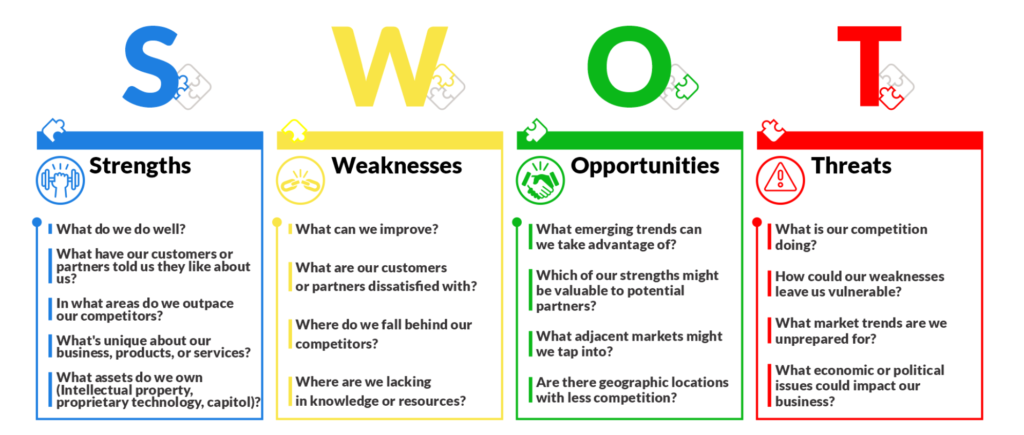
You can identify what areas your competitor excels in, as well as where they may have weaknesses that can be exploited. You can also use it to identify any opportunities or threats associated with their activities that could potentially affect your own business. As you evaluate each component of their competitive strategy (business model, sales approach, marketing campaigns), take note of how their performance ranks compared to yours in these categories.
Once you have identified the relevant metrics within each category (products/services offered, pricing and promotion, customer service, content, and SNS strategy, etc.), list those findings in a document for easy comparison between yourself and rivals.
Determine Your Competitive Advantage
It is a vital step in conducting a competitive analysis. Your competitive advantage is the distinctiveness of your company – it’s what sets you apart from other companies in the same space, the edge that allows you to appeal to your target market and gain an edge over competitors. Start with SWOT and analyze where you stand out, as well as areas where there is room for improvement or opportunities to fill a GAP in the market.
Once identified, use the knowledge to inform and influence strategic decisions moving forward. Build campaigns emphasizing those unique points on which the business stands out, and create initiatives that capitalize on any weaknesses found within competitor businesses during research. Not to rely too heavily on external stimuli, instead, strive for consistent improvement across all aspects of the business, independent of outside competition.
What To Do After Completing Competitive Analysis
Implementing your strategy. Take some of the ideas you’ve come up with and start working on them individually. Don’t try and emulate all of your competitors at once – focus instead on a few strong points from each competitor you analyzed. Don’t forget to constantly measure how well you’re doing against your chosen goals. Completing a competitive analysis helps give businesses a better understanding of their market landscape and position among competitors – both current and potential ones.
Using strategy canvas allows teams to break down competitors by various factors such as pricing, service offerings, and features – giving added clarity into where opportunities exist for differentiation or innovation within existing markets or new markets altogether.
It is important not to forget about measuring results against competitors over time – making sure your products remain ahead or at least comparable in terms of value proposition over time.
Competitive Product Analysis
It is used to reveal the key distinguishing factors between products that are vying for the same customer base. This kind of comparison between competitors can help you identify areas where you may be losing potential customers, and make sure that you stay ahead in your respective market.
Access Your Current Product Pricing
Accessing your current product pricing is a key step in the competitive product analysis. To start off, gather all relevant data about competitor prices first, to understand how they are positioning their products. It should include the prices that each competitor charges for similar products and services.
It is also important to note whether your competitors have adopted certain strategies when it comes to setting up their prices, such as premium pricing (high initial cost but low operating costs) or value-based pricing (pricing according to the customer’s perceived value).
Compare Key Features
It involves analyzing the features of your product and determining how they are different from your competitors. It is important to note the similarities and differences between both products in terms of features, usability, quality, and other areas. It will help you gain insight into how your product stands out compared to your competitors’ offerings.
Considering the range of products each company offers and how each feature affects the overall customer experience. Evaluate how well each feature stacks up against its competitor in terms of costs, usability, functionality, design, aesthetics, customer service support offered, and any other distinguishing factors you may find relevant to customer satisfaction.
Pinpoint Differentiators
Differentiators are the features that make your products stand out from the competition, allowing you to emphasize its USP. It is important to identify what makes your product different and better than the competition by looking at a variety of criteria.
The quality difference can be a KEY differentiator. You should also compare the customer service experiences available. Cost savings might come in the form of complimentary delivery or special discounts on already discounted items.
Differentiators could also include things like having an app or extra support such as live chat or 24/7 access to customer advisors via phone. Ultimately, understanding what makes your product stand out will help you focus on those key factors when marketing your offering and create a compelling message that resonates with consumers.
Identify Market Gaps
It means understanding what customer needs are unfulfilled and how your company can use those gaps to get ahead of its competitors. Market gaps can be identified by analyzing competitor offerings, customer reviews, industry data, and customer feedback.
When looking for market gaps, it’s important to analyze what features/services are missing from existing products/services that could improve the customer experience or fill a need that has not currently been met. You can observe how competitors interact with their consumers – this will provide valuable insight into opportunities for improvement to differentiate your offering from theirs & secure more customers.
Market gap analysis should include discovering emerging trends within the industry as well as monitoring current customer behaviors such as preferences, and purchasing habits, so you can stay ahead of growing expectations. Any emerging technology or innovative tactics used by competitors should also be considered when searching for potential opportunities to leverage your own offerings.
By using all those methods, you will have a better understanding of where you stand in comparison with other rivals and a crystal-clear idea of which areas need improvement within your organization’s capabilities to remain successful.
Conclusion
A thorough analysis of the competition allows businesses to understand their place in the market and identify areas where they can improve. It should NOT be a copycat game, as the goal is to use what businesses are doing as an example of how to create something even better than what is currently being offered.
Equally important is understanding what customers want and need, which can be achieved through competitor analysis. By providing better services than competitors, businesses will be better positioned to increase customer loyalty and gain a competitive advantage.
Ultimately, successful competitive analysis strategies allow businesses to anticipate the needs of their customers and gain a clear understanding of their competitors – ensuring they stay ahead of the competition and remain profitable.