
There are a wide variety of tools available for modeling businesses before giving birth to your new venture. The goal of this guide is to make you visualize the canvases like simpler mental models, by dividing them into macro perspectives before you start visualizing and filling each block individually.
Back Stage vs Front Stage
One way to better understand your business model when using the BMC is by applying the metaphor of a theater. Watch your BMC as if the right side of the canvas were the front stage of a theater, and the left side is the backstage.
Front Stage=Right Side
In a theater, the front stage is where all the action takes place. It’s the reason why people go to the theater and what they pay for. It is where the value is visible to the audience. And this is pretty much the same when it comes to the BMC.
The right side is composed of the blocks of customer relationships, customer segments, channels, and revenue streams, and encompasses everything your customers/users can actually see. It is the way you interact with them, what represents value to them, and what they are willing to pay for.
Back Stage=Left Side
The backstage is the place behind the curtains, that makes the show on the front stage possible, and what drives the cost of the production. But the audience won’t see what’s happening there.
The left side, composed of the blocks key partners, key activities, key resources, and cost structure, includes everything that makes the right side of the canvas functional. Most customers will not see who’s working there and what is being done.
The Theater Metaphor and The Canvas
The final equation is as simple as the metaphor: a sound and sustainable model is one where the revenue generated from the right side is bigger than the costs involved in the left side, resulting in profit.
Left Side: Business – Back Stage – Business Process
Right Side: Customer – Front Stage – Customer Facing
It is important to start filling in the canvas from right to left since the right side is where the revenue comes from. For most businesses, the imperative areas are the value proposition & customer segments.
It is good to start with the customer segment, in order to understand who the audience you will serve is and what problems you can solve. Then you’ll able to add value to these customers’ lives. In the value proposition block: the benefits your product can bring to your customer.
Next areas: Channels (the means you will explore to make the value proposition reach your customer), Customer Relationships (the way you will attract and retain customers), and Revenue Streams (how your audience will pay for the value received). Having the right/front side set, move to the left side/backstage.
Define the Key Resources, by setting everything that is fundamental to running the business, and what the Key activities that the business needs to perform in order to deliver value are. Then Key Partners – partners/suppliers that could help you start and develop yours. Finally, you will have to figure out how you are going to pay for all assets/actions involved in the backstage. What are the costs to produce and deliver the value proposition to the end customers. They must be listed in the Cost Structure block.
Front Stage Disruptor – Dollar Shave Club
DSC disrupted the Theater Formula by selling shaving products directly to end consumers, thus dismissing the retailers in between. It reduces the structure/power of the backstage, merging marketing and distribution, and thus creating direct access to consumers.
Backstage Disruptor – Waze
Waze disrupted the Theather by depending on its own users to build its value proposition. Because the drivers who use the app are precisely the people who will provide all the data Waze collects to offer directions. So there is not an actual differentiation between users/producers. The user base is precisely the competitive advantage that no other traffic navigation system has gotten before.
Efficiency v.s. Value
Another way to divide the BMC into two parts is by separating the business share and the customer share, or the production from the consumption side.
Right Side=Value/Customer/Consumption Side/External Factors/Dynamic & Changing
- Customer Segments: the audience you aim to serve, segmented based on their needs, desires, and personal/social features
- Channels: the means through which your business will reach the targeted customers and deliver value to them.
- Customer Relationships: the kind of relationship you intend and need to build with the targeted customers, in order to ensure the communication, and success of your business.
- Value Proposition: the products/services your business delivers in order to meet the needs/wishes of your customers. It is what distinguishes your company/brand from the competitors, by assuring a unique experience among the end consumers.
Left Side=Efficiency/Business/Production Side/Internal Side/Static & Repeatable/Long-Range Thinking
- Key Activities: the essential activities for delivering value to the customer
- Key Resources: all the resources needed in order to produce value and keep the activities running
- Partner Network: the necessary relationships with suppliers, investors, and other partners that allow the production and delivery of value
The Bottom=Finances of the business
- Cost Structure: all the costs involved in producing/delivering the value proposition to the customer
- Revenue Streams: how the audience pays for the value proposition received
Create, Deliver, and Capture Value
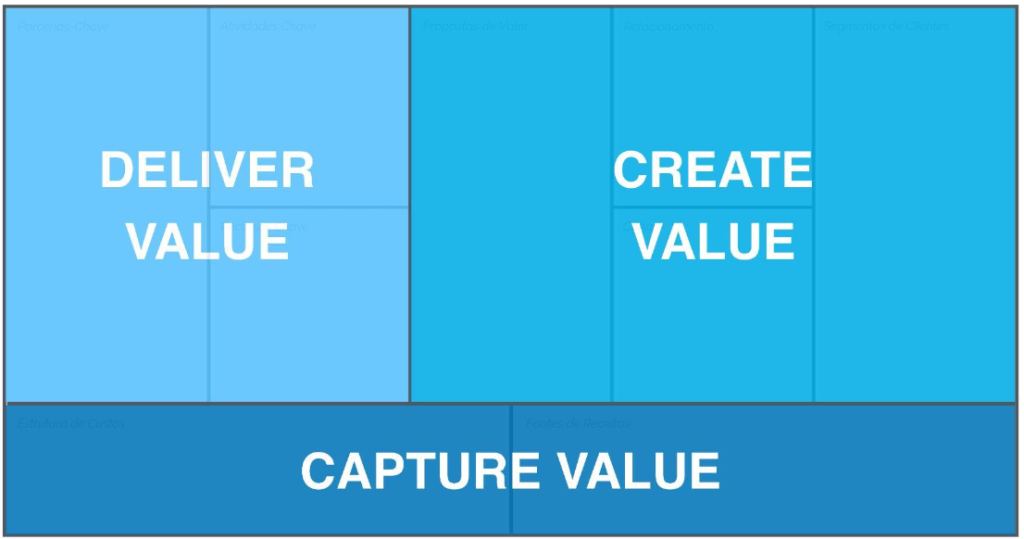
A business model describes the logic of how a company creates/delivers/captures value. The right side is where the value is created, the left side is where the value is delivered, and the bottom is where the value is captured.
It reflects companies’ hypothesis about What customers want, How they want, and How an enterprise can organize the best to meet those needs, get paid for doing so, and make a profit.
Feasibility, Viability and Desirability
It is another way to look at BMC is by applying a mental model from design thinking, first proposed by world-renowned design firm IDEO. You will achieve innovation when you get to the intersections of desirability, feasibility, and viability.
The product/service needs to be desirable by customers, and at the same time, it has to be technologically feasible and economically viable. Separating the blocks into three divisions:
Right Side=Desirability
The right side focuses on the customer, about creating value for them. The risk you face is solving a job considered irrelevant by your audience. The section includes four blocks: Customer Segments, Value Proposition, Channels, and Customer Relationships.
To build a desirable product/service, you need to understand the problems/expectations of your audience (customer segment), develop a solution that meets the needs/interests (value proposition), select means to reach the customers (channels) and communicate effectively with them (customer relationships).
Left Side=Feasibility
The left side concentrates on the infrastructure you need to produce/deliver your value proposition. The risk is poor execution. Three blocks in this section: Key Resouces/Key Activities/Key Partners.
To develop a feasible operation, you need to establish all the essential assets to deliver the solution (key resources), the fundamental activities that must be run in order to produce the solution (key activities), when necessary, select relevant partners that will make the processes easier/useful (key partners).
Bottom=Viability
The bottom is about the financial situation of the business model. The risk here is precisely not setting it right. This part encompasses the final two blocks: Revenue Streams, and Cost Structure.
In order to find a viable business, you need to build some models and test them. It may be difficult since it involves forecasting revenues and costs. However, it is imperative that you get as close as possible to the total expenses of production/operation, including salaries/materials/marketing/sales (cost structure), as well as to how and how much the customers will pay for the solution (revenue streams).
Adaptability
Besides all three sections, it is important to highlight adaptability: your ability to predict and deal with external factors/threats, such as competition, changing techs and regulations, and more.
Right vs Left Brain – Lean Canvas
Left Brain (Logic) the Right Brain (Emotion), the left brain refers to analytical thinking, verbal/methodical, and is responsible for reading, writing, logic, sequencing, computations, mathematics, and facts. The right brain is more creative/intuitive and has a less organized and more artistic way of thinking, connected to imagination/intuition/arts/rhythm/feelings and daydreaming.
Left Brain=Left Side
The left side of the lean canvas should be filled in a logical/analytical way. The product is presented, by defining the problem it can solve, the solutions addressed, key metrics used for evaluation, and the cost structure. Everything is very logical and methodical.
Right Brain=Right Side
On the right side of the lean canvas, there are the market needs, where you need to use your creative skills and emotions, in order to develop opportunities. The right side is about all the strategy that is going to be used to attract and retain customers, and how they will pay for the value received.
The Brain Metaphor & Lean Canvas
Both halves of our brain can not function independently. The two hemispheres are tied together by fibers, which deliver the information. They have to complement each other, and we never use only one side of our brain at a time. This can also be applied to the Lean canvas, the canvas is not a sum of two sides. It has to be analyzed and filled in as a whole, as both sides depend on each other to work properly.
Product v.s. Customer – Value Proposition Canvas
The value proposition canvas aims to create a fit between the product and the market. In order to achieve that, the tool focuses on positioning the product or service around the customer’s values and needs.
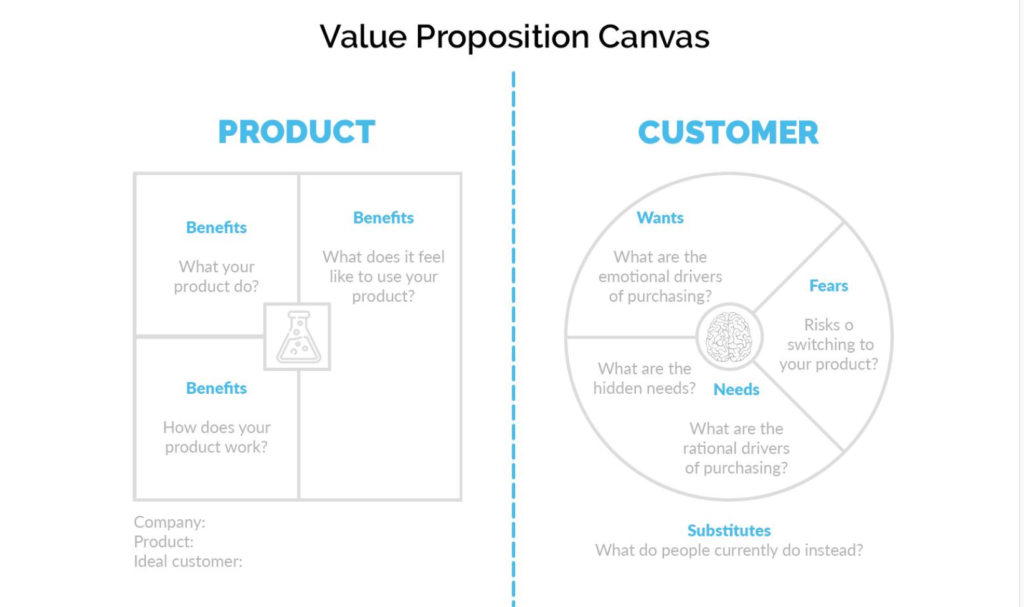
Right Side=Customer
- Jobs-to-be-done: what your customer is trying to do, the problems they want to solve, and the needs they want to satisfy, with all the different roles they have to perform.
- Pains: what disturbs the customer when executing their jobs to be done, the challenges, risks, costs, consequences, etc.
- Gains: what the customer expects, wishes, and everything that may make their life better
Left Side=Product
- Products/Services: info about the product/service, what it is and how it works
- Pain Relievers: how the value proposition relieves the customer’s pains, costs, negative feelings and experiences, efforts, risks, etc.
- Gain Creators: how the value proposition benefits the customer and makes them happier
Understanding the macro levels of a business model can help you better understand how they function, and how to better design them, in order to predict threats and opportunities and, thus, avoid failure.
It is important to highlight that the BMC is not only greatly useful when you are getting started with a business, but also while your company is already running, especially if you need to review your strategy and find new ways to innovate.